Feeds:
Posts
Comments

Sometimes when we are on the road to excellence, we get a little tired. We wish we were already there. We wish the road had a literal signpost saying “You have made it, and you can officially stop worrying and consider yourself to be awesome.” We wonder if we should have chosen something easier to do with our time. And we think that maybe there is a magic bullet, something we can do that will–Bibbidi bobbidi boo!–make us more amazing.

Let me make this part of the road simpler for you.

There are no short cuts. There are no magic bullets. There are no sure things. There are no easy paths. So if you want something quick and easy, excellence isn’t the end goal for you.

Photo by Trey Ratcliff

Sure, there are activities beyond diligent practice you can do that will help you progress. In writing, these include attending workshops, reading slush, seeking out critique experiences, reading craft books like The 10% Solution, etc. In singing, these include participating in master classes and workshops, auditioning, obtaining performance opportunities (however humble), studying with different teachers, etc. But none of these methods are foolproof, and not all of them will pan out.

Take the various Clarion workshops, for example. Working professional writers often cite their Clarion experience as being pivotal in their development as writers. These are the stories about Clarion that we hear most often. But then there are the writers like Alexandra MacKenzie, who took ten years after the workshop to be ready to learn from one of her instructors. Because you can’t always control the timing of these sorts of things. And there are also the Clarion attendees who stopped writing altogether; these are the ones we hear about the least, and yet they assuredly exist. Why? Because no way of leveling up is foolproof. No way of advancing works for every single person.

The path to excellence doesn’t often go flat like a plateau only to suddenly rocket steeply upwards into awesomeness. It is a gradual process, a long slow incline upwards. As Seth Godin says, it is a series of hills, one after another. Those who continue to improve keep choosing new hills to climb that are just on the edge of their abilities.

Sometimes the path feels like a flat-line that suddenly springs up, but this is an illusion. I saw it all the time with my students in voice lessons. They would work steadily and gradually improve, so gradually that they didn’t even notice it happening. They would struggle with a concept and it wouldn’t quite be clicking, and they’d get frustrated and discouraged. At this stage in the process, it was my job as the teacher to keep pushing them, keep encouraging them, keep them singing even if they were ready to throw in the towel. And then inevitably, they’d finally understand. Their bodies would finally coordinate correctly, the muscle memory would finally develop, the ideas we were talking about would finally make actual instead of theoretical sense. And they’d experience a leap in ability. A leap that was really a slow mounting of ability all along.

That leap in ability is just around the corner for all of us. If we practice diligently and intelligently (directed practice as opposed to blind repetition), we are pushing ourselves forward along the path. The leap may come next week or it may come next year. It may come after we take a month-long break or it may come after a few weeks of intense practice. We don’t know when it will come. Excellence requires us to have the faith to sustain us while we work.

We must believe the leap will come. But it won’t come because of magic. It will come because of our own hard work.

I have devoted my life to the pursuit of excellence. The Greeks called this areté, striving for excellence, living up to the best of one’s potential, and facing challenges with courage and persistence. I wanted to be the best student. I wanted to become a skilled singer. I wanted to travel around the world. I wanted to be an effective teacher. And now I want to be a masterful writer.

Areté has been one of the driving forces of my life. I care about people and relationships, I care about my health (only because I can’t get away with being indifferent to it), and I care about excellence. That’s not to say I don’t have other interests, passions, and concerns, but these three things I think about every single day.

Here’s the thing about mastery: it tends to be all-consuming. It requires commitment to make your practice one of the highest priorities in your life. It requires patience and fortitude while you struggle to improve. It requires the willingness to be bad (especially when starting out) and the strength to fail.

J.S. Bach--an undisputed master of musical composition.

Mastery takes time. It’s not easy to achieve, and anyone who tells you otherwise doesn’t know what they’re talking about (or they’re looking for a snappy headline that will drive page views or book sales). I used to have voice students come in for lessons, expecting to become fabulous singers with a month or two of lessons (and barely any time outside of that devoted to practicing). Guess what? They never became fabulous singers. They learned some basics, and that’s as far as they went. (Strangely, parents understand this about their kids and usually (although not always) insist on more commitment. Adults were by far the most egregious in terms of thinking singing would be an easy skill to acquire.) Sure, some of my students could skate by on their natural skills for a while, only to eventually arrive at the realization that if they wanted serious chops, they’d have to put the effort in.

Mastery takes focus. I’ve always hated it when people ask me what my hobbies are. The question triggers me to think about how I spent my time. For years, the real answer was: I sing in different genres. I play the piano. I love to sight-read. I compose and write songs. I adore musical theater. I think about educational theories and new ways to help my students learn. I think about the psychology of singing.

Nowadays, I write and I read. I analyze and research and think and learn. I go to bookstores and conventions and signings. It’s not that I have no interests outside of writing, but I have to dig deeper to unearth them for casual conversation, and I have a tendency to relate my other interests to writing in one way or another. Have a bad experience? Well, it will be useful for my writing sometime down the line. Like RPGs or theater? Well, they let me study different ways to structure stories. Travel? Broadens my horizons and lets me envision worlds outside my daily one.

Mastery takes diligence. I love this example of Steve Martin. He devoted himself to learning how to perform live comedy and play the banjo. Then he changed over to making movies. Then he changed over to writing fiction. Then he began to focus some more on the banjo again (and won a Grammy for his efforts). The article (which you should go read because it is super interesting) posits that his success is due in no small part to his practice of diligence.

Commitment. Time. Focus. Diligence. And the dream of someday being able to accomplish what you can only imagine right now.

What is that elusive concept in writing known as voice? Plot, character, setting, world building, theme: all of these aspects of fiction, while complicated in their own right, are at least fairly simple to explain as basic concepts. But for me, voice has always been trickier to talk about in an intelligent way. I know it when I see it, but what is it that I’m noticing?

First, I’d like to differentiate between authorial voice and narrative voice. By authorial voice, I mean a way of writing that is unique to the author, so that you can read a story by him and know who wrote it by how it is written. Ernest Hemingway has a particularly distinctive authorial voice. So does Herman Melville. By narrative voice, I mean the voice of the protaganists in the story. In first person, this voice completely permeates the text, but even in close third, the descriptions and prose will be affected by whose point of view we are in. (Don’t take these definitions as a golden standard, by the way; the internet disagrees about what these terms mean, so I’m merely sharing my own personal definitions so we can understand each other.)

When we talk about voice in YA, the voice we are usually talking about is narrative voice, not authorial voice. The narrative voice will change from novel to novel and story to story by the same author (except in series). For example, the narrative voice in M.T. Anderson’s Feed is very distinct from the narrative voice in his Octavian Nothing novels.

What does the world look like through her eyes?

So what aspects contribute to a specific narrative voice?

1. Vocabulary and word choice, aka diction: What is this character’s likely vocabulary? What words does this character use that may be unique to her world? How much slang is used? How can the choice of words reflect this character’s reality?

2.  Range of language: Possibly a subset of word choice. How does this character speak differently to different sets of people? How does this character’s thoughts differ from what he says out loud? Does the range of language change over the course of the story in reaction to external events?

3. World view/perspective and experience: The perspectives of the character reflect themselves in the voice. This includes her backstory, her priorities (look at how obsessed with food Katniss is in The Hunger Games, for example) and views of the world.

4. Psychic distance (a term coined by John Gardner): This refers to the distance the reader is held from the story and is related to POV. In YA, this distance tends to be close and  immediate, which is why first person is so popular in the genre.

5. Syntax/sentence length and pacing/density of prose: YA tends to be less densely packed than some adult fiction; to see what I mean, compare Ian McDonald’s Planesrunner (MG, but still a good example) to his adult The Dervish House, or Paolo Bacigaluipi’s Shipbreaker with his adult The Wind-up Girl. Pacing in YA tends to be on the faster side, although there is plenty of adult fiction that is paced just as fast or faster (and there are the occasional slow YAs). Boy books in particular tend towards the fast paced.

6. Maturation of voice over the course of the narrative: Because most YAs are, at least in part, coming of age stories, the voice generally changes as a consequence of maturation and realizations. The change is often subtle.

7. Emotional urgency: YA highlights emotional urgency. Everything is a big deal or the end of the world because the protaganist lacks the experience to see things differently. Speculative YA often literalizes the metaphor and deals with the actual end of the world or life and death situations.

8. Dialogue: The dialogue in fiction directly illustrates the characters’ personalities and way of speaking. It allows us to experience their actual out-loud voice.

9. Interior monologue: This is a critical component of voice in YA. It is used to convey a character’s reactions, emotions, judgments, perspective, and sense of humor. It shows how a character feels about herself as well as the world around her. It allows the readers to understand and feel for the protagonist. (And according to agent Krista Marino, this is the aspect of voice that is most often missing from YA manuscripts that she reads.)

As you can see, voice and character are inextricably linked. In order to be effective, the narrative voice must fit the character, sound like the character, and reveal the character. The better you the writer know the character, the more likely an authentic voice will emerge in your work. (Or conversely, sometimes you may grow to know the character through his voice, depending on how you work.) YA voice in particular is very close to the protagonist(s), very emotionally immediate, and reflects the unique experience of a person in her teens. The voice in YA often changes and matures over the course of the story, and spends time focusing on the internal dialogue of the protagonist as well as the external dialogue.

What did I miss? Please feel free to weigh in.

Further Reading/References:

Perfecting Your YA Voice Part 1, by Ingrid Sundberg

Perfecting Your YA Voice Part 2, by Ingrid Sundberg

Evolving Voice in the Young Adult Novel, by Swati Avasthi

YA vs. Adult: Do You Have the Voice?, by Heather Howland

Narrative Voice and Authorial Voice, by Ruth Nestvold and Jay Lake (This article talks about both narrative and authorial voice, but while I’m a bit unclear as to its actual definitions of the terms, I believe they are different than the definitions I use above.)

I was talking to a new friend at Epic ConFusion about YA and the difficulties that many newcomers to the genre (especially those writers who started in adult markets) have in identifying it. This may be the reason why we keep getting these awful panels at sf/f cons that devolve into an hour-long discussion trying to differentiate between Middle Grade and YA (even though that is not the topic) or complaining about Twilight (which has gotten to be quite old hat). In an amazing recent SF Signal roundtable (which I hope to blog about more extensively soon-ish), Malinda Lo said, “Perhaps I’m the odd one out, but I guess I don’t think the definition of YA is that hard to pin down. I feel that publishers and the YA community have a pretty clear idea of what it is, and it’s folks who are new to YA who don’t understand and often make assumptions about what it is and who reads it.” Which is exactly the problem: the YA community knows exactly what YA is, but writers from other communities? Maybe not so much.

I’ve spent the last three years reading YA (and a bit of MG on the side) voraciously, and so yes, I have a pretty clear idea of what YA is. I told my friend that many times, the place where writers go wrong when trying to write YA is the voice of their novel. When trying to quantify that more for him, I could only say, “I know it when I see it.”

While it’s nice for me to be able to know it when I see it, that assertion is problematic on a few levels. It means I can say, “No, this isn’t really a YA voice,” but then draw a blank when I have to explain why that is so (not so helpful for other writers, is it?). It also means that I can’t work as concretely on improving my own YA voice. So obviously working to analyze what YA fiction really is and breaking down the different components that contribute to a YA voice is very useful. I’ve always wanted to attend a panel titled “The Differences Between Adult and YA Fiction,” but I haven’t seen it yet. So consider this that panel, and hopefully I can encourage others who know YA well to contribute to the conversation in the comments.

Yay, reading!

So what makes YA different than adult fiction?

1. The age of the protagonist: In YA, the protagonist is almost always a teenager, theoretically 14-18 years old. In practice, I haven’t seen that many 14-year-old protags–they indicate borderline Middle Grade (which is for readers age 8-12, and these kids tend to read up) and tends to read on the youngest side of YA at best. So practically speaking, 15-18. In a novel set in the modern world or its equivalent, the protagonist is always a high schooler. The summer after high school is fair game, but anything beyond that (read: college) is usually not done (which is another post of its own).

2. POV and tense: Arguably the most trendy POV and tense in YA right now is first person present tense (although I’m seeing something of a move away from it recently). First person past tense and limited/close third person past tense are also okay. Omniscient is out of fashion just like it is in adult fiction. Most novels limit themselves to one or two POV characters. If there are two POV characters, they often (but not always) change in alternate chapters. A trend right now is to have one female and one male POV that alternate chapters.

3. Tone: YA fiction can run the gamut between very light and very dark. It’s hard to go too dark, and there are very few taboo subjects.

4. Theme: YA fiction covers many themes, but very often feature some kind of coming-of-age plot. The teenage protagonist vs. society is also very popular (hence the dystopia, for example), as are issues of identity, peer relationships, and romance.

5. Genre: The most popular genres right now are paranormal and dystopian. The dystopias are beginning to show more sf-nal elements (yay for YA in space!), but dystopias and post-apocalypses are still the most common. There are also the high fantasies and the historicals (historicals w/ fantasy elements are probably more popular than the straight ones). In contemporary, we have the “issue” books, the romances, the thrillers, and the just plain contemporary books.

6. Boy books vs. girl books: I hate that this divide exists, but it does. Boy books usually have a male protagonist, and get readers of both genders. Girl books are more likely to have a mostly female audience. Boy books tend to be more externally focused, plot focused, and full of action. They often read a bit younger to me than girl books. Girl books tend to be more internally focused and usually include a romantic element. Some books lie somewhere in the middle and are particularly awesome. For example, John Green tends to write contemporary novels with male protags who are more internally focused, and The Hunger Games has a female protag and is full of action; there is a love triangle, but it’s not the primary focus of the story. (This is also its own blog post, and a super touchy subject, so keep in mind I’m doing a fast and dirty summary, and there are many exceptions. That being said, people in the industry do talk about “boy” books, so it’s a reality in the marketplace right now.)

7. Narrative Voice

We can see from looking at the above list how critical narrative voice actually is. YA is basically a teenage character reflected in the narrative voice of the novel who is embroiled in a plot that is relevant to them. Krista Marino says, “An adult looking back on the teen experience is an adult book.” It follows, then, that a YA novel is filtered through the immediate viewpoint of a teenager. And so much of how that viewpoint is expressed is through voice.

Next time, I’m going to break down voice into various aspects so we can hopefully gain a better understanding of what it is and how it contributes to that YA feel of “I know it when I see it.” In the meantime, please feel free to comment below and tell me your opinion: what I missed, what I got wrong, examples in current YA novels, questions, etc.

Bad Luck, Good Luck

I am a very unlucky person:

I had a difficult childhood. I suffer from chronic health problems. My mom died when I was nineteen. I don’t fit in easily with many groups. I attract people to me who take advantage of my over-niceness/over-empathy. Sometimes people have treated me very poorly. There have been many times in my life when I’ve been forced to make hard choices. I’m a little bit accident prone. I’ve had dreams and aspirations that haven’t come true and never will in the future. I get rejected a lot. Sometimes people don’t listen to what I have to say. I have often felt very isolated.

I am a very lucky person: 

I gain immense personal satisfaction from my creative work. None of my medical issues thus far have been life-threatening or impacted my quality of life permanently. Also I have health insurance. I take a great deal of joy from life, both from the small things and the large ones. I have traveled all over the world. I have been able to spend the majority of my life pursuing interests and careers that I deeply care about. I had access to a good education. People have gone out of their way to be helpful and kind to me. I am able to change. My empathy allows me to connect with people on a deeper level.  I have a lot to look forward to. I have plenty of resources and opportunities. I have been able to help and inspire people. I have people (and dogs) who I love deeply.


These are both stories I can tell about myself and my life. Both of them contain statements of truth; both of them contain some statements that have nothing whatsoever to do with luck (and some that do).

I had trouble writing the unlucky one. Not because I was making things up, but because that is not the predominate story I tell myself. It’s the one that creeps up on me when I’m tired or discouraged or in pain. It’s the one that makes me doubt myself. It’s the one that makes me want to choose the easiest way.

The lucky story is what I tell myself every day. It is where I find much of my happiness.

In which story do you spend most of your time?

My husband often reads out loud to me before we go to sleep. We most often read children’s classics and more recent middle grade novels because I want something interesting but not so exciting that I can’t go to sleep. We’d just finished a few books by Bruce Coville (if you’re interested in MG fiction at all, you should run outside RIGHT NOW and buy some of his stuff, because he’s fabulous), and after some pondering, for our next read we’d selected The Absolutely True Diary of a Part-Time Indian, by Sherman Alexie.
Warning: There be spoilers ahead!

My husband began to read, and the book was well written, interesting, and had a sense of humor. But within a few pages it was clear that for his first dramatic incident, the author was going to kill a dog. I told my husband to stop reading because *@*%@*%!!*!! I am so incredibly done with reading about dogs dying.


I am TOO CUTE for your shenanigans!

Here is a list of the dying dogs in fiction I have encountered in the past three years: The Knife of Never Letting Go, by Patrick Ness (I was bawling so hard at this one that my husband got worried); a story in Paolo Bacigalupi’s Pump Six; The Big Splash by George Galuschak; “I Can’t Imagine” by Sandra Wickham; and Mama, We Are Zenya, Your Son, by Tom Crosshill. At Taos Toolbox, Nancy Kress told us about her novel Dogs (which I refuse to ever read) and Eric Kelley threatened to kill off the police dog in one of his novels-in-progress. In Working Stiff by Rachel Caine, the dog is threatened, and in Robert Sawyer’s Mindscan, the dog is unable to recognize its master in his new robot body (which completely broke my heart). And these are just the examples I can think of off the top of my head.

Seriously, writers, WE GET IT. Killing off the dog (or pretending you might) is very, very sad. It reliably makes me cry even if I don’t like your story very much otherwise. And it also shows up the bizarreness of human behavior, that we cry when an animal dies and not when a person dies (although to be fair, I often cry when writers kill off people, too…but never for the bad guy, which says something else interesting). So could you please stop now?

Also, do you ever notice how writers don’t seem to kill off cats? (Not that I have anything against cats.) Why all the dog hatred, writers, huh? Why not pick on those of the feline persuasion for a change? Why do you want to violently dispose of sweet little bundles of fur like this?


You know you want to pet me!

I’ll admit, the “pick on the cute and loyal dog” thing used to be shocking. But now, it just makes me feel tired. It makes me want to stop reading. It has nothing to do with the merits of the work (if you’re not as sick of dead dogs as I am, you’ll want to check out everything I referenced above). But it’s become even more unpleasant to me than werewolf tropes, and you know, that’s saying something.

So please, the next time you consider killing off the poor innocent puppy to pull some heartstrings, back away slowly. Maybe you can kill off the bratty kid sister or the brooding and boring boyfriend instead. Or, I don’t know, have your protagonist lose a finger or something. Just enough with the dogs.

Thank you.

*****
I’ll be in Detroit this weekend for Epic ConFusion. Say hi to me if you’re there!

I was having dinner with a friend the other day, and he mentioned that he hadn’t gotten around to reading any of my stories yet. He followed that up by saying that he was a little nervous to do so because they might reveal that disturbing things go on in my mind. (Newsflash: I’m a writer. That implies a certain level of creativity, which means at least a touch of disturbing is probably going on in there.) He didn’t say he was afraid he wouldn’t like my stories, but I’ve certainly had other people express that worry to me.

This conversation made me realize that what I take for granted, being around writers all the time, might not be so obvious to others. So here is an insider’s guide into how writers deal with each other.

1. Writers read a lot. But we cannot read everything.

Writers are fighting a never-ending war against the gigantic pile of stuff that they’re supposed to be reading. It’s a good thing most of us started out as enthusiastic readers because otherwise we’d drown in the amount of material we try to get through.

We read the novels in our own genre. Some of us have more than one genre, so then we have to read novels in two genres. Plus we are supposed to read novels outside our genre to stay well-rounded, so we have to read those too. Then there is the nonfiction that we have to wade through, some for specific research purposes and some to generally better understand the dynamics of the world we live in. We read short fiction and articles and blog posts. We read magazines about our industry. We beta-read novels for fellow writers, and we read to critique short stories. We read for award season. Sometimes we have students’ work to read, or books to read in order to give a blurb or review. We read and read and read.

We cannot humanly read everything. We cannot even read everything by our dear writer friends. It is impossible.

LESSON: We understand that you might not have time to read what we write, either. We LOVE it when you do, but there is no obligation.

2. Writers don’t always love each other’s work.

One of the first published novelists I got to know told me that it was really awkward to be friends with a writer whose stuff you don’t like.

Happily this has not proven to be true for me, and I don’t think it’s true for many writers. At least I hope not, because every reader (writers included) has her own individual taste, and not everything ever written will fall into that taste. This doesn’t mean that the writers who write stuff not to my taste aren’t fabulous people who I enjoy hanging out with, though.

Writers hardly ever ask each other the following questions: Did you read my latest story? Did you like my latest novel? Do you think I am the most Awesome Sauce Writer that ever lived? Instead, we may congratulate each other on milestones that we are aware of (hey, congrats on winning that award, or congrats on that book deal). If we have actually read and enjoyed a work, we might then say something about it unprompted (hey, I read your book and I loved the protagonist). I have NEVER told a fellow writer that I read their work and then proceeded to tear it to shreds, because that would be completely inappropriate. Mostly, writers spend a lot of time gossiping and talking about each other’s work-in-progress.

LESSON: You don’t need to tell your writer friend whether you read their work unless you did so and would like to share how much you enjoyed it. We know our own work won’t be to everyone’s taste, and most of us know better than to put our friends on the spot.

3. Writers don’t always write stuff that is autobiographical or has deep personal significance.

In the TV show Gossip Girl, there is a budding writer who only writes autobiographical stories and models his characters directly from his life. Everything he writes has deep personal meaning and reveals his true feelings about those around him.

This is FICTION. Many writers do not write autobiographical fiction. That’s not to say there’s not a part of themselves in the work, but often it is very hard to tell which part unless you know them very, very well (in which case, it shouldn’t come as too big a shock). Many writers do not model their characters directly on a real-life person (I don’t know that I’ve ever done this, for example). Many writers do not reveal their deep, dark secrets in the text of their work. Sometimes (often, in fact) they just make stuff up because it will make the story more awesome.

Writers do often re-visit the same themes over and over. For example, I like to write about death and mortality. That fact tells you something about me, but it’s not something I try to keep hidden. Sometimes a writer’s general personality is reflected in their work (although not always), in the sense that when you meet the writer, you think, “Ah yes. I can see how this person would have written that book.” But this is all fairly surface personality kind of stuff, nothing that should be particularly alarming.

LESSON: Writers are not constantly revealing their deepest, darkest secrets in their fiction.

Is there anything I’ve missed? What are some other common misconceptions that might make non-writers uncomfortable when dealing with writers?

Sometimes I miss the people who are no longer here.

Some of them are dead. Some of them (most of them) I didn’t know all that well. I miss the ones who died young in a special way, because I’ll never find out who they might have been. I had a high school classmate who died within a year or two of graduation. Ironically, I think about him more than I would have if he were still here. Him being missing leaves questions that I know can never be answered.

Most of them, though, aren’t dead. They’re just gone. They’re out there somewhere (as far as I know) doing a lot of the same things I do: eating, sleeping, working, playing, talking, making new things. Occasionally I might spot their phantom electronic footprints. But our circles never intersect. We are the parallel rays in a geometry problem, branching off into our own separate infinities.

Except when I think of them.

The people who are no longer here have left their shadows behind, encased in my neurons. They do not know what I think, what I feel, the personal story of my existence, but they remain a part of me. Most of them touched the events of my life, but the most enduring of them changed who I am. I still hear their voices echoing forward from the past.

I feel their absence.

The ones I miss the most are the ones I love the most. Love/loved, it all blurs together, but in my memory it remains present tense. I wonder why we’ve formed our own worlds (no fault, though, because fault is for frightened people). I wonder if we think the missing is better than the reality. I wonder if it’s true that time is malleable so I can bend it backwards through these small gaps and spend another moment in their company.

Most of them will never read these words. A few will, but I might never know.

I miss you. The ghost isn’t the same as the original.

I don’t really like pain, and I don’t like to feel uncomfortable. Sometimes I daydream about my ideal life, when I have fixed all my problems, have everything I want, and am exactly where I want to be in my career.I will never achieve that ideal life. And thank goodness, because if I did I’d be bored stiff…in which case I would have a problem, wouldn’t I?

Seth Godin published an insightful post last week entitled “Trading in your pain,” in which he outlines two common problems we can have due to our relationship with pain.

The first is the “if only” syndrome. We think if only something (fill in the blank) happens, then everything will be great and we won’t feel pain/discomfort/ uncertainty anymore. If only I meet the right person. If only I buy the right house. If only I remodel. If only I get an agent. If only I sell my first novel. If only my sales figures exceed a certain golden number. If only I win this award or make that bestseller list. If only I get this promotion. If only I was better or had more or …

That’s not generally the way things work, though. Whatever “if only” you’re hoping for (and I’m holding out for several myself), even if it happens, it will open the way to new challenges, new problems, new if only’s, and new pain as you strive. That’s okay. It doesn’t mean you’re not doing well. It doesn’t mean you’re not good enough. It’s just life.

The second is the “fear of change” syndrome. We sometimes become comfortable with a certain flavor of pain or discomfort, and we hold onto it really tightly so we won’t have to deal with another, unknown flavor instead. We become frozen. Stagnant. Afraid of success and the new problems success will bring us. Afraid of a different failure mode and how that will make us feel.

Behind the GateWriters who don’t write are having this second problem. They are used to dealing with the failure mode of “I suck because I’m not writing” and don’t want to address whatever issues might come up if they actually did write: “I suck because I’m not selling” or “I suck because I’m not selling enough” or “I suck because now I have to make business decisions” or whatever.

But I see this problem everywhere, not just in writers. We make ourselves at home with a certain problem, and settle in for keeps. And in the process, we get stuck. We can’t move on; we can’t grow.

Our identity and our personal narrative become entwined with our pain. I’m the girl whose mother died when I was only nineteen. That’s not who I am anymore. It is, however, who I could have been. It is who I was for a period of years. And then I let go and moved on. Instead I’m the girl who loved her mother very much.

Pain can be your friend. It will be lurking nearby for your entire life, and that’s okay. It means you’re alive, and it reminds you that you care what happens. It can push you forward instead of holding you still. It can give you focus instead of causing you to scatter. It can make our priorities clear to us.

If you could shed one “if only” or do one thing that makes you frightened, what would it be?

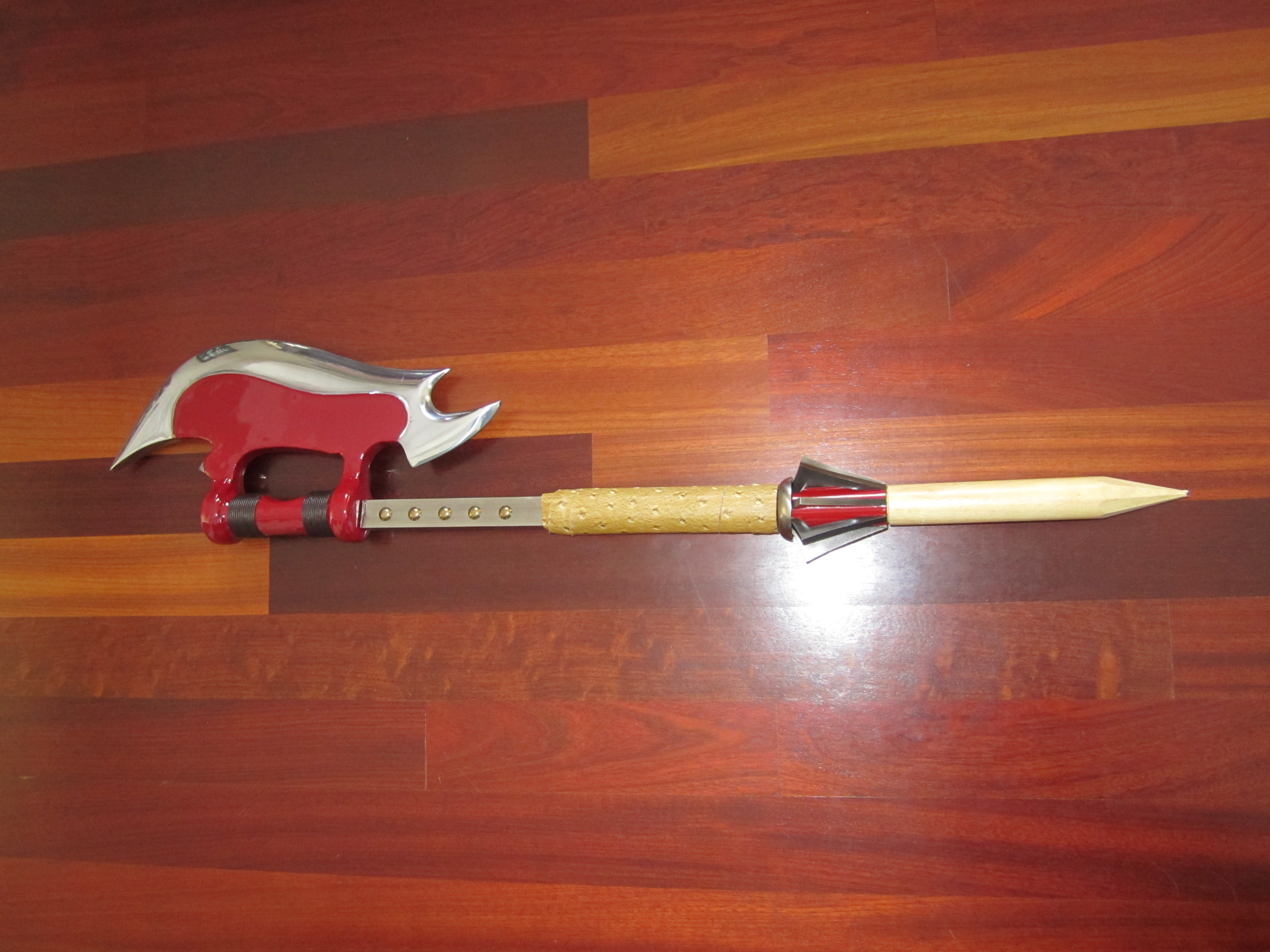
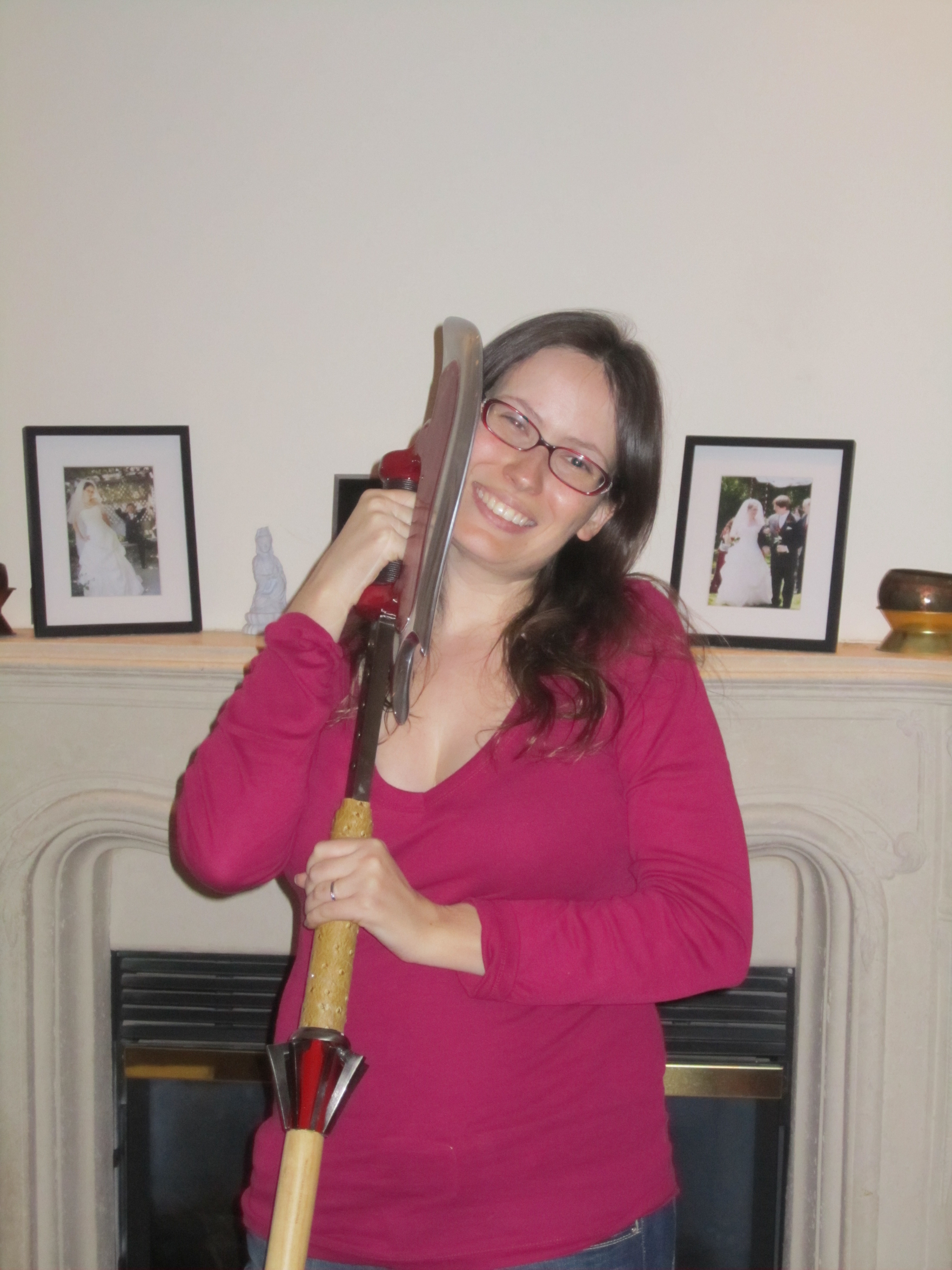
Yesterday, I received my symbol of the year in the mail.


Yes, it is the Scythe from Buffy the Vampire Slayer Season 7. Full geek points to you if you recognized it. For those of you not familiar with the show, the Scythe is a mystical weapon forged for the Slayer (into every generation she is born: one girl in all the world, a chosen one). It’s also something of a deus ex machina, but hey, we’ll let that go because of its shiny awesomeness.

This year, I get to be my own chosen one. The Scythe is a symbol of power, both external and internal. To me, it represents courage and strength: to make tough choices, to trust myself, to believe in myself, and to really go for it this year. I think I might hang it over my fireplace.

I love my Scythe.

Award Season

If you read other SF/F writer blogs, you know there is that inevitable time of year when they post a list of work that is eligible for awards. Yup, it’s that time.

My short story “Forever Sixteen,” published in Daily Science Fiction, is eligible to be nominated for the Nebulas and the Hugos.

I am also entering my first year of eligibility for the Campbell Award (for best new writer in science fiction and fantasy), which you can nominate for if you are nominating for the Hugos. Here is a list of my publications to date; if you’d like a copy of anything on the list, I’d be happy to send one to you if you leave a comment below or email me at practicalfreespirit@gmail.com.

Lastly, Catherine Schaff-Stump reminded me that I am also eligible to be nominated in the Fan Writer category of the Hugos for my work on this blog. How awesome is that? You can check out an overview of my work here on my Best Of Blog page.

Right then! Does anyone else have a symbol for the year? It doesn’t have to be a large weapon that you want to hang over your fireplace. It doesn’t even need to be something you own. If you have an idea, please share below!