Today is a travel day, so here, have a photo of a cute little dog:

Adorable.
She took advantage of the chaos of moving to find a particularly comfortable place to sleep.
Today is a travel day, so here, have a photo of a cute little dog:
Adorable.
Posted in Uncategorized | Tagged Amy Sundberg, Nala | 1 Comment »
Please note: This essay is not an invitation to comment on my physical appearance. Any such comments will be deleted, even if they are complimentary, because that is counterproductive to the point I’m trying to make.
When I was a teenager, it was very clear to me that it mattered very much how I looked.
And I looked all wrong. I had an awkward phase that lasted years and years, complemented by having a mother who took no interest in physical presentation. So I didn’t know what clothes to wear that would flatter me. I didn’t know how to take care of my hair, or how the right haircut could make a big difference. I learned everything I knew about makeup from Seventeen and being in the theater. The style of glasses at the time was unfortunately large.
Eventually I figured most of these things out. I got better glasses. I started getting my hair cut and learned of the wonder that is conditioner. A few female friends in college went shopping with me and taught me about non-baggy clothing, and I began to develop my own sense of style.
I recently read Justine Musk’s post about the perception that women tend to be vain, and it struck a real chord with me. She goes on to say: “Even today, in 2014, the culture transmits the message to girls and women that there’s a direct correlation between looking good and being loved – or at least not being openly mocked.”
A few years ago Lisa Bloom wrote about how difficult it can be to refrain from complimenting a little girl on her appearance at the beginning of an interaction. She makes the effort, engaging girls about their interests and thoughts instead, because “teaching girls that their appearance is the first thing you notice tells them that looks are more important than anything.”
I’ve been taught since I was quite young that a real part of my worth is in my appearance. How many movies have I seen where the awkward nerdy girl gets a makeover that consists of tossing her hair around and pulling off her glasses? And then suddenly she’s worthy of attention and love and respect. The Princess Diaries. She’s All That. My Big Fat Greek Wedding. If the Shoe Fits. Grease, Mean Girls, and The Cinderella Story sans the glasses part of the equation. And let’s not forget The Breakfast Club. If we look at the quintessential Cinderella fairy tale, sure, Cinderella is patient and good and virtuous. But she needs her fairy godmother’s help with a makeover in order to win the heart of a prince. (The class implications of many of these makeover stories are fascinating as well. See Pretty in Pink.) The theme of transformation can be a powerful one, and an outer change can act to highlight an internal change, but the message is still clear: you are judged by your external appearance.
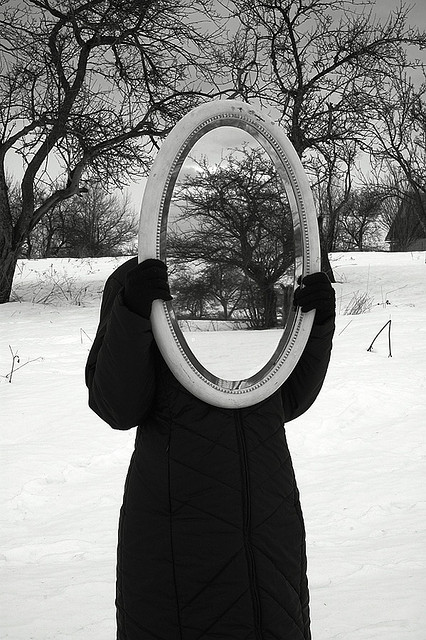
Photo Credit: Camil Tulcan via Compfight cc
At the same time, women are criticized and called vain for caring about their looks. It’s a Catch-22 in which the “right” physical appearance is supposed to come naturally and effortlessly. We are not supposed to care about how we look, and we’re certainly not supposed to be aware of how we look (that would be conceited), but we are taught that our looks are paramount. And thus thinking we don’t look the right way leads to all kinds of psychological problems.
I don’t think there’s anything wrong with experimenting with personal identity by having a makeover (or several). I don’t think there’s anything wrong with expressing who we are through our physical appearances. And how we hold our bodies can affect both how we feel about ourselves and how we are perceived. For better or for worse, the art of personal presentation, or style, if you will, can deeply affect how others see us.
But when we teach that physical beauty is the main path to love and worth as an individual, we are teaching shame. We are teaching people to hate their bodies, to be uncomfortable, that they are in some essential way not good enough. We are creating impossible situations. Would we prefer to be vain or unattractive? Must we fall into the small band that our society deems to be traditionally beautiful in order to receive respect? And what if we can’t?
And so we put on a tightrope act. I think of physical presentation as a kind of game, and I’ve learned enough of the rules and conform to enough of the standards that it’s no longer such a painful one. I usually know what rules I can get away with breaking, and I can get away with it because of the ways in which I already conform and the place where I live. Not everyone has these luxuries. Meanwhile, unplugging entirely from the game can come with its own consequences, not least among them having to live with the general consensus that it’s okay to make negative comments to someone else about their appearance.
For myself, I try not to confuse vanity and conceit with confidence. Having confidence in yourself, which includes your physical body, and becoming comfortable in your own skin is not something that is wrong or shameful. As Theodora Goss says in her post with advice about how to be photogenic: “You must believe you are beautiful.”
Yes. Yes, we must.
Posted in Life, Society | Tagged Amy Sundberg, appearance, beauty, makeovers, vanity | 3 Comments »
One of my favorite blogs, Captain Awkward, recently had an article filled with tips on how to make friends, which I found fascinating since it’s a great analysis of the logistics of how to be social. One of many excellent points made was on the effort it takes to be social:
“Having a social life takes work. Some people make it look easy, or find that it comes more naturally, but there is emotional and mental work involved in planning events, researching them, being the one who takes the lead on inviting people places, remembering their birthdays and what foods they can’t eat, keeping the cabinet stocked with snacks in case people drop by, asking how their day was, showing up to things when you have limited time and energy, etc.”
I’ve been thinking about this more than usual lately because I feel like I’m falling behind on my social life. Actually, scratch that. I am falling behind. Messages and emails sit in my inbox for days, and I don’t have time to get around to them, or even worse, I forget all about them. There are people who are going through big changes with whom I want to have long conversations, and instead we’ve exchanged a few sentences via text. I haven’t been making as many plans overall. And forget about making many plans more than a few days ahead of time.
Of course, this is all fall-out from the recent move, not a normal state of affairs. The move has been taking huge amounts of time and energy, and I only took three days off from writing–last time I moved I took weeks off–so I haven’t gotten much slack there. And I’m just so tired. Too tired to plan ahead. Too tired to answer emails before I go to bed. Too tired to go back and forth several times in an attempt to schedule something. (Interestingly, not too tired to offer emotional support when asked for or to hang out when the scheduling is easy and doesn’t require much of me. I’ve even had a few group game events at my new place, which is not yet all the way unpacked. There were even snacks at the second one, which took, amazingly enough, ADVANCE PLANNING.)

Nala is also very tired.
It’s really interesting watching myself fall behind because it makes me realize how much time and energy I usually do spend on being social. And I wonder if I make it look easy. I certainly forget myself how much energy I’m expending until a time like this when I don’t have the energy to spare.
What’s great is that during the times when everything is going more or less smoothly, we all build up social capital from all that social effort enumerated in the quote above. And that social capital doesn’t disappear overnight, which hopefully means we are granted some slack when life does a double flip and decides to join the conga line. It definitely means that in spite of the fact that I feel massively behind, I’m still receiving support from my friends at a time when I particularly need it.
I’m also noticing how some of my social rules–and again, Captain Awkward nails them in her post–really do work to save energy. The “only invite someone two (maybe three) times to do something, and then move on unless they reach out” rule? So useful as a way to cut down on effort. As is the “name a specific time and place instead of the vague sometime” rule. And the “if they never invite you to do anything, you can let it slide while you’re busy” rule. Not to mention the “go ahead and invite someone; as long as you’re polite, the worst that can happen is they say no” rule.
This all makes me realize what a privilege it is to have a social life. Because it does take time and effort. Because it does require putting ourselves out there, and it does sometimes result in disappointment, both of which draw on emotional reserves. And because I live in an area where it is fairly easy for me to meet people who are accepting of who I am and with whom I have things in common.
So right now I have too many balls in the air and occasionally I drop one of them, and sometimes it rolls off behind the sofa where I don’t even remember it’s hanging out. And my social energy is not what it usually is. And I can see why that’s happening and try my best to be patient with myself, while appreciating all the times it doesn’t happen.
Do you have any social guidelines like mine or Captain Awkward’s? If so, I’d love to hear about them.
Posted in Life | Tagged Amy Sundberg, friendship, socializing | Leave a Comment »
I often say that I assume everything I put on the Internet is public. Some sites are explicitly public, like this blog and my Twitter account. Others aren’t quite as obviously public, like when I post to my friends only on Facebook or on a members-only forum. But ultimately, everything I post on the internet is just a screen shot away from being 100% public, so I operate under the assumption that it’s public and go from there.
What I don’t think I’ve talked about is our interactions with other people on the internet, and how they are affected by being online.
Following from my earlier rule of everything on the internet being public, our social interactions with people on the internet are also often public. But I’ve noticed that we often appear to forget this is the case. And trouble ensues as a result.

Photo Credit: CasualCapture via Compfight cc
I’ve compiled a list of internet social etiquette ideas derived from this principle:
1. Personal conversations on social media: Let’s say you and a friend are catching up at a coffee shop and talking about your personal lives. And then let’s say you find out the guy at the next table over has been recording your entire conversation. Creepy, right?
But you are doing the same thing to yourself when you have personal conversations on Twitter, on comment threads, or on Facebook walls. Those conversations are recorded for all to (potentially) see. So make sure these are conversations you wouldn’t mind having the rest of the world overhear. More personal conversations might be better suited for email or various messaging options (IM, Facebook messages, Twitter DMs, etc.).
2. Criticism on the internet: When you criticize someone on the internet, you are doing so in a public forum. This is much more likely to make the person being criticized feel threatened and defensive, and to result in non-productive communication. Sometimes public criticism is appropriate and meets your goals; other times, not so much. Consider if you’d feel comfortable making the same statements at a party, in a group of friends, or even on a panel. If the answer is no, you can always say something privately to the person instead.
3. Are these people worth your time? In public, when I meet people who are egregiously rude to me, don’t listen to what I have to say, and are espousing a lot of ideas I find offensive, I tend to cease engagement with them. I know I’m not going to change their minds, I know I’m not going to change their friends’ minds, and I know I don’t want to be treated poorly. Comment threads are often no different. They are not always worth your time. And having to engage repeatedly with such people is definitely not worth your time. What do you when at a party with such a person? You excuse yourself and you avoid, avoid, avoid. Doing the same thing on the internet is totally allowed.
4. Am I causing harm? Holding a private opinion and making a public statement are two very different things. Once you decide to turn a private opinion into a public statement, you have to consider both your reach and the effects of your statement. This requires a lot more reflection and research. Do your very best to get the facts. Use sources that have solid credentials. Consider consequences. I don’t think any of us wants to be responsible for the resurgence of measles in the United States, and most of us don’t have a reach as big as Jenny McCarthy’s, but the consequences of public statements are real and something for which we share responsibility.
5. Public mistakes require public apologies: We all screw up from time to time. But if you accidentally make a mistake on the internet, you need to make amends publicly as well. A private apology is all well and good, but not enough if the social interaction in question was public. And if you’ve broken someone’s trust in public, expect to have to work hard to regain that trust.
What are other common social pitfalls on the internet? Any suggestions on how to handle them gracefully?
Posted in Social Media, Society | Tagged Amy Sundberg, etiquette, internet, public vs. private, social media | 1 Comment »
In both composing music and writing, we talk about the value of limits.
Shouldn’t the imagination be limitless, you might ask?
Well, yes and no. Without some sort of structure within which to organize the imagination, the end result tends to be disjointed, rambling, and/or incoherent. Structure tends to allow the impact of a work to be more easily conveyed and understood. Even experiments in looser structure or “no” structure are informed by their structure or lack thereof, and they are using that difference or lack to say something.
This is why in music we have different forms: the sonata, the concerto, the art song cycle, the rondo, the fugue. Each form has its rules, and the rules must be understood before some of them may perhaps be broken or subverted or played with. In a similar way, prose has different forms, common structures, and genres that form sandboxes within which we play. (And even if we leave the sandbox all together, it’s rare that our work isn’t somehow informed by that fact.)
Structure lends definition to our ideas, which in turn gives us more artistic freedom. If we literally have every single note of every single rhythmic value at every time at our disposal, there are so many possibilities it becomes difficult to think. We face decision paralysis, or at the very least spend huge amounts of time considering such a large number of alternatives, most of which wouldn’t be very effective at all in practice. Structure frees us to consider more possibilities by narrowing down the scope of our canvas.

A very structured waffle. I can attest to the fact that it was quite delicious.
Sometimes life feels very similar to me. As nice as all that advice sounds to “live life without limits,” if you spend more than a few minutes thinking about it, it’s simply not practical. We are constantly placing limits on ourselves and our lives: where we decide to live (or if we decide to be nomadic, because that places different constraints); what careers/education we decide to pursue; what lifestyle choices we make; how we spend our time. Because each minute we decide to spend practicing piano is a minute we aren’t going to be spending writing or cooking dinner or hanging out with family or what-have-you. Ultimately we are limited by the number of hours in the day, by the number of hours we need to spend sleeping, and by our finite life spans, as well as by a host of other individual mental, emotional, and physical traits.
While some of these limits can be frustrating (why do I need eight hours of sleep per night? why?), they ultimately allow us to set our priorities and pursue our lives according to what we value and find important. Overall this is a positive thing.
Except when it isn’t. We become so used to living within limits and imposing more limits upon ourselves, at a certain point we might stop being conscious with our decisions. Not only that, we might not even recognize there is a choice in the first place. This is when limits move from being a force of good to being a force that holds people back.
Limits help us make decisions, be who we want to be, and accomplish what we want to accomplish. But limits also exist to be questioned. It is only through questioning that we can discover which limits are useful and which are unnecessary. It is only through questioning that we can determine which limits are real and which are unconscious beliefs we hold that might not actually be true.
It is only through questioning that we can realize our full potential, whether that be in a specific creative project or the creative project that is life.
Posted in Life | Tagged Amy Sundberg, limits, priorities, structure, writing | Leave a Comment »
I had a conversation with a new acquaintance who told me that when he is in a romantic relationship, he pretty much falls off the face of the earth when it comes to his friends. And not just during the “honeymoon” phase of the relationship, either, but for the entire duration. And he seemed pretty content with this state of affairs.
But this conversation made me realize (yet again) how very important it is to ME to have my social ties.
I’ve been thinking about this too because I have a few close friends who have embarked on new relationships in recent months. They’ve made it a point to continue to spend time with me and not fall off the face of the planet. But I’ve been very aware of this as a choice we get to make.
I read an article recently about what makes people happy (because those articles are one form of my crack, along with sugar and chai and adorable little dogs), and the first secret mentioned was friends and the existence of social support:
“Turns out, there was one—and only one—characteristic that distinguished the happiest 10 percent from everybody else: the strength of their social relationships.”
Notice the plural of that last word? I’m willing to go out on a limb and bet that one social relationship is not what we’re talking about here. Social relationships, whether they be friends or family or colleagues or communities, are so important to general well-being. And putting all of that into one relationship is like the old cliché of putting all your eggs into one basket. It puts an awful lot of strain on that one basket.
To be clear, I don’t think a person needs huge amounts of social ties in order to be happier. Some people do, and other people need a few close ties. I myself fall somewhere in the middle. In other words, this isn’t so much an issue about extroverts vs. introverts, but more, I think, a question of having any healthy system of social support.

Friends! Also, Innovation! Photo by Yvette Ono.
Unfortunately we live in a culture that sometimes idealizes romantic relationships–the One True Love, the one who will complete us, our other half–to the detriment of other relationships. Add in a Puritan work ethic that teaches us to neglect social ties in favor of working ever more hours to get ahead, and we end up discouraging people from forming and maintaining the social networks that will make them happy. Even the rise of the nuclear family in American life contributes to this effect, as it is easier to maintain social ties while raising children within a more collective approach to child-rearing.
Luckily, I believe in the power of priorities and persistence. (And apparently also the power of alliteration.) If we choose to place a high priority on our social connections, and if we continue to pursue this goal even when it is hard–and making friends as an adult is not always an easy business–then it is very possible to have the social support that we crave. And this makes us happier to boot!
How important are your social ties to you? How do you maintain them even when you’re busy and/or distracted?
Posted in Life | Tagged Amy Sundberg, friendship, priorities, social support | 1 Comment »
It is April 1st, and I have officially moved. All my stuff was in one place, and now it is in a different place. It is mostly in boxes, which is admittedly sad for me. But it is here!
Meanwhile, I am completely exhausted. I want to lie around and do not much for the next several weeks at least. I am not going to do that, because I have a novel to write and stuff to remove from boxes and place in spots that look purposeful. But it sounds like a lovely idea.

Nala and I, collapsed on the floor.
I gave up the keys to my old place yesterday, and I did feel a pang. I tend towards the sentimental, and even more so when I’m tired. I was only living there for one year, but it was certainly an eventful year, not to mention a year surprisingly well documented with photos. I have many happy memories of time spent in that condo.
It’s strange how leaving a space feels like leaving something more intangible behind. I’ve heard people reference the memories that live in the walls, and I suppose that is some of it. But there’s also, I think, the more pervasive feeling of change. Now that this one major part of my life has changed, how are the ripples of that change going to spread? I’ve talked before about being in a liminal space, and moving certainly triggers that experience, of transition and being in between.
I think maybe that’s why I’m so tired. Okay, realistically, I’m so tired because moving is a huge amount of work and expense and stress. But I also feel slightly off balance, like things are in motion but I’m not quite sure what all they are or where they’re going.
It’s somewhat comforting to consider, then, that my priorities remain much the same. Nala, my novel, my friends. Settling into the new place and getting my body back to its normal state after all the moving strains. Thinking interesting and challenging and wonderful thoughts.
Things change and things stay the same, all in a strange concurrent muddle of life.
Posted in Life | Tagged Amy Sundberg, change, liminal spaces, liminality, moving, priorities | 1 Comment »
I thought about writing a substantive post, but I still have some boxes to pack up, so I’m going to keep this short.
This morning I’m picking up the keys to the new place and starting the process of turning it into my new home. I’m also taking a few days off from writing because…so many things to do and not enough time to do them in! I’m sad because I don’t want to take any time off from writing; I want to finish the rough draft of this novel. But I know it’s only a couple of days, and I’m sure I’ll be busy enough to be distracted from the writing withdrawal pangs.
I thought you might enjoy seeing the current chaos that is my living space:

So many boxes everywhere.

These boxes hold most of my library.
I’m a little nervous because expense! And change! And what if I don’t like it! But I also know that I have all the raw ingredients to create another lovely home nest for myself. This place that I’m leaving felt like home very quickly, and I know that was because of the people I filled it with. Home isn’t so much about the walls and the layout and the roof (although having shelter is up there on Maslow’s hierarchy of needs). It’s about safety and friends and a little white dog and a piano. It’s about game days and movie nights and chatting on a sofa that has seen better days. It’s about brownies and take-out sushi and curling up in a blanket with a good book and writing writing writing.
The next few days will be closing one chapter of my life and beginning a new one. I’m aiming to do so with grace. I know I am doing so with hope for what the future might bring.
Posted in Life | Tagged Amy Sundberg, home, moving | 2 Comments »
I thought I’d write today about self care, since I’m in the middle of a move, and moving is on that list of highly stressful life stuff, which means self care is something that I’ve been making extra effort to pay attention to right now. And it’s actually working; my stress levels are on the high side but not crazy high, and I have been having cheerful and happy times in spite of the move, and without that weird frantic edge that signals the presence of overwhelm.
So here are some self care things I’ve been doing:
1. I talk about the move. Whenever I want (within reason). This is huge because it means I’m getting emotional support during a high stress time. I’m getting to vent, I’m getting feedback about what’s going on, I’m getting comfort when I need comfort and celebratory time to help me remain positive about all the good things this move is going to bring. And it’s such a relief to have people know what’s going on with me.
2. I ask for help. This past weekend, my friends came over and helped me pack my entire place. In mere hours they completed a job that would have taken me days and days and reduced me to an incoherent, exhausted, and injured person. One of my best friends came with me to see the place I ultimately decided to rent to give me a second opinion. Other friends have been giving me information about the neighborhood and reaching out to give me doses of moral support. Feeling so supported and cared for definitely reduces the stress I’m feeling.
3. I fight the impulse to be frugal. When I know something is going to be expensive (like, say, moving), my first impulse is to do whatever it takes to save as much money as possible. This attitude puts a lot of additional stress on me, to put it mildly. And it’s so much easier to be frugal when you’re not in the middle of a mini-crisis. So I’ve been allowing myself to hire the movers who are slightly pricier than I feel completely happy with, and to pay for extra body work so I don’t fall apart physically, and to spend money to make problems less huge.
4. I make sure I have time for classic self care. Did I have a Gilmore Girls marathon, complete with frozen pizza and strange pie, a few nights ago? You bet I did, and I appreciated the energizing alone time. I’ve also been prioritizing sleep, walks and snuggle time with Nala, and hot tub time.

One of the pillars of my self care routine.
5. I take advantage of focus but rein in bigger ambitions. Things are going so well, I think to myself, perhaps I could up my daily word count, or query more agents, or do some more semi-stressful social things. And then I realize that no, instead I can appreciate that things are going well and keep the pace I set myself, while resisting the temptation to push myself too hard. I don’t have to do all the things right now. I can focus on my five top priorities and let the rest go. (For those curious, those are moving, novel, Nala, personal growth/care, and friends.)
6. I give myself a reward. When the move is completely over, I get to go to Seattle for a week. Thanks to frequent flyer miles and wonderful friends, I have an amazing trip to look forward to. So whenever I think, “Ugh, I hate moving,” I can then counter with, “But then I’m going to Seattle!” And then I can add on, “Plus my friends are fabulous! And I love the novel I’m writing!” Which makes it really hard to spiral into serious negativity. So maybe this one isn’t so much about giving myself a reward and more about feeling gratitude.
Of course, none of this would be as effective without this last one:
7. I clean up my life in the hopes that one crisis/setback won’t set off a chain reaction. I spend time with people who are good to me. I set and hold boundaries. I cultivate good things so it is easy to find gratitude.
Here’s to leveling up with my self care.
Posted in Life, Personal Development | Tagged Amy Sundberg, asking for help, boundaries, gratitude, priorities, self care | Leave a Comment »
While I was at my annual writing retreat in the rainforest this year, I had an interesting experience. It was Saturday morning; I had already been writing intensively for two days, and I had one day to go. I launched myself into a scene in my novel that was particularly emotional and heart wrenching.
By the time I finished writing the scene, I’d become so deeply involved and invested in my protagonist that I was literally very upset. I felt like I’d gone through an emotional wringer: my chest was tight, the place behind my eyes ached, my breathing was more shallow. It was time to go over and have a communal lunch of homemade soup and grilled cheese sandwiches, but I found as I ate my mind wandered back to the scene I had just written, and I was having trouble focusing on conversation.
My heart felt bruised, and it took a few hours before I felt more like myself again.
I thought of this experience when I stumbled across an article in the Atlantic: “How Actors Create Emotions: A Problematic Psychology.” It talks about the research being conducted by assistant professor of psychology Thalia Goldstein about the links between psychology and acting. In the article, she talks about the distinctions between pretense, lying, and acting from the perspective of cognitive psychology.
What many writers of fiction do is very related to this as well. We joke about telling lies for money, but most of us also believe that what we’re doing when we tell a story is communicating an essential truth through our fiction. Nancy Kress, my teacher at Taos Toolbox, compares her writing process to Method Acting, and I go about much of my writing in a similar fashion. I inhabit the lives and worlds of my characters, and I try to feel as they feel. Just as actors experience psychological effects from their acting, so too do fiction writers. And it’s part of our job to learn how to deal with such effects in a healthy way.

Photo Credit: Phil W Shirley via Compfight cc
The article cites Tony Grego, a well-known acting teacher, who says: “And you can imagine that if you decide to take on Blanche DuBois, when the play is done you don’t go home and not think about all the questions that these great roles bring up inside of you. If you really decide to go where these great roles will take you, then you come out of them a changed person.”
And if you really decide to go where your story, your novel, your characters are taking you, then in the process, you the writer will change. It’s not that every word I write changes me, but I am a different person at the beginning of a novel than at the end of that novel. I even change over the course of a short story, although usually not as noticeably.
I wonder if this is true of all art, that in the process of creating it and engaging with difficult questions and truths, the artist inevitably changes. I also wonder if this is one of the reasons why art does make us feel more alive, because it is forcing us to grapple with truth in different ways than we are otherwise called upon to do.
Back to the retreat. I let myself feel those feelings that had arisen from writing my emotional scene, and I reminded myself where the feelings had come from. I gave myself some space, had some food, took a little walk. And they faded. But the experience of writing that scene and going to the place my character needed to go to be true has made me a richer person. And that’s what I’ll carry with me going forward.
Posted in Uncategorized | 1 Comment »

 The Practical Free Spirit