I’ve had many people ask me about Taos Toolbox, the speculative fiction writer’s workshop I attended this past summer of 2010. Here’s the scoop on what my experience was like. Please note, however, that every year will inevitably be different, both in terms of participants, lectures, and details.
Taos Toolbox is a two-week residential workshop in the high mountains above Taos. It is run by Walter Jon Williams, who teaches with one other writer (for my year, this was Nancy Kress, who will also be teaching in 2011). During this time, each attendee has the chance to have two pieces critiqued.
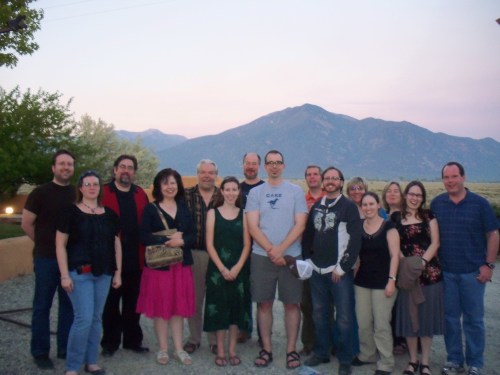
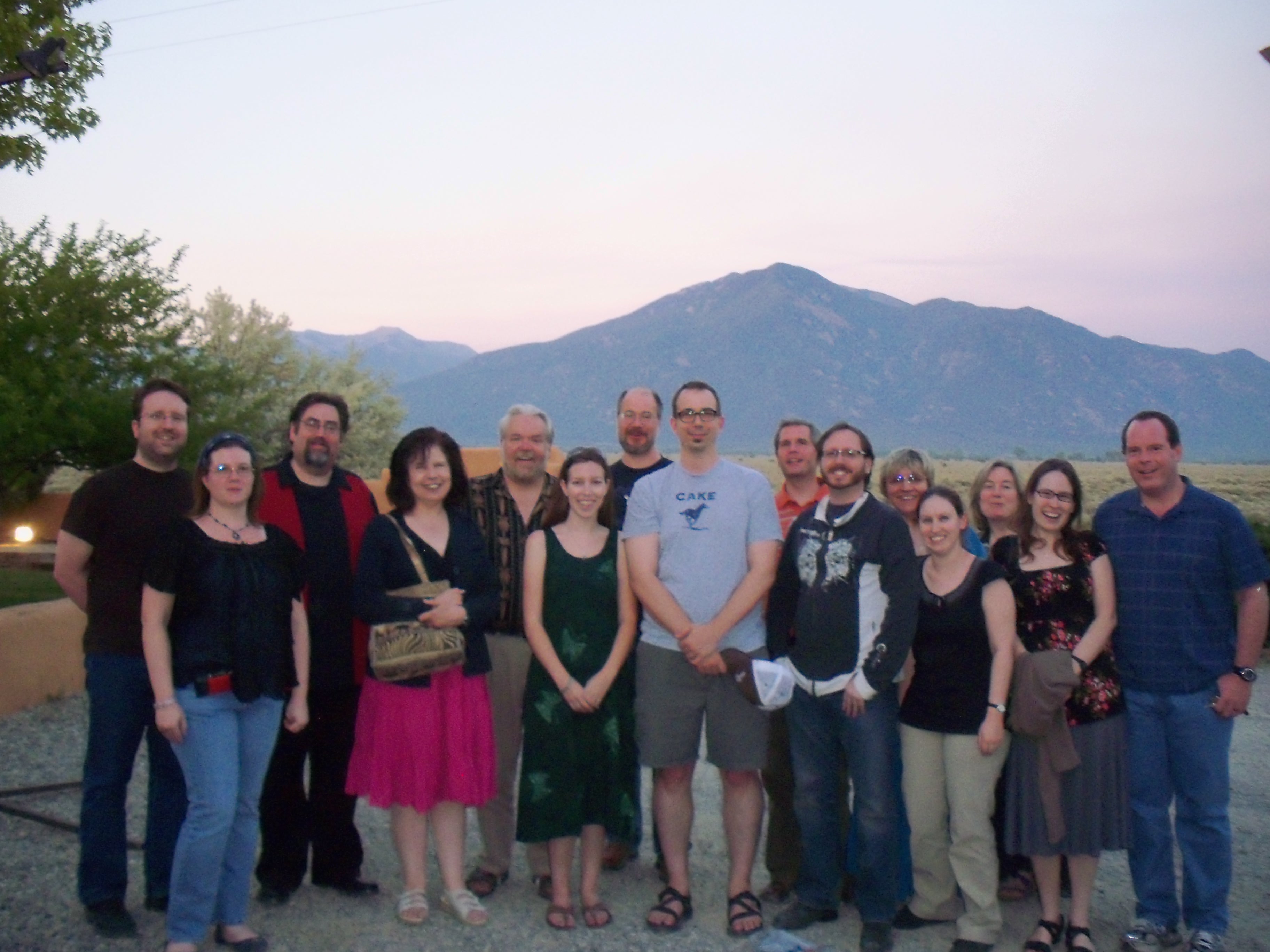
My Taos Toolbox classmates
Pros of Taos Toolbox:
1. The shorter time (2 weeks) is easier to fit into life without massive restructuring.
2. Participants can work on either short stories OR novels. Both lengths are addressed in lecture. In my year, I’d say about two-thirds of the attendees presented the first section of a novel plus a synopsis for at least one of their two pieces. However, I opted to turn in two different short stories and also received valuable feedback. So there’s flexibility here.
3. Walter Jon Williams and Nancy Kress are both experienced writers AND teachers. Not everyone who can write can teach, but these two certainly can. I learned a great deal about many aspects of craft and business during my two weeks.
4. Because the two teachers are teaching together and present for each other’s lectures, that means you get two different views on many subjects. Walter and Nancy are perfect for this because they don’t have the same writing process at all.
5. The location is gorgeous and secluded. You really do feel like you’ve gotten away from it all. But there was (in my year, at least) still internet and cell service, so you’re not completely cut off.
6. As with other workshops, by the end of the two weeks the group had really bonded and I now have many new wonderful writer friends. We’re still regularly in touch both one-on-one via email and social media, and through our email list. I see Danielle every few weeks for coffee. We’re planning other writing and critiquing events and hang out at conventions. We even read each other’s blogs (hi guys!)
Potential Downsides:
1. Yes, it’s a wee bit expensive. But do remember that your fee covers the instruction and critiques from two top pros, most of your meals (except for a few dinners), and your lodging. Personally, I felt like it was worth every penny.
2. The altitude can be a killer, so be warned. In retrospect, I wish I had come a day earlier and slept in Albuquerque for a night to help my body adjust.
3. It’s intense and involves a lot of critiquing. A lot. Happily I learned a lot from all the critiques, whether on my own or other people’s work. However, if you are not comfortable receiving criticism, this might not be the workshop for you.
Format and Logistics:
Every weekday, we’d gather at 10am and usually meet until around 3 or 3:30pm, with a lunch break somewhere in the middle. During this time, we’d listen to two lectures, one from each teacher, and go through that day’s critiques, Milford style. Each student had a two-minute time limit on critique-giving, although Walter and Nancy could speak for as long as necessary. We were also assigned various writing exercises.
Afterwards we’d have free time to write or critique. Many people took advantage of the free time to go down to Taos for sundries or take hikes in the surrounding mountains. There was also much hanging out, playing music (Rich brought his guitar), soaking in the hot tub, and movie watching. (Walter does a plot breakdown of The Maltese Falcon that shouldn’t be missed.) We were provided with three meals a day during the week, and everyone had their own room.
I will add that I was unsure if I was qualified enough to attend the workshop, being unpublished and never having attended other workshops in the past. Obviously it worked out well for me, and I’d encourage you to apply if you’re interested and let Walter and Nancy decide if you’re at a level that could benefit from the instruction.
Topics of Instruction:
- Cleaning up prose
- Story and structure
- Writing in scenes
- Plotting (WJW and NK have fairly different approaches to this.)
- Literary elements and rhetorical devices
- Plotting elements and maintaining suspense
- Narrative modes
- Analysis of specific works
- Opening Scenes
- Writing description
- Characterization
- World building
- Business and contracts
- Commercial fiction, genre, and issues specifically relating to spec fic
I would say that overall, the greatest focus was on plot and structure (and related topics).
What I Learned:
Do I think my writing improved due to my Taos experience? Yes, indeed. One of my critique group members back at home even commented on the difference. My understanding of the various elements of writing fiction has been deepened in a variety of big and subtle ways. For example, when I arrived at Taos, I was relying on intuition and my experiences as a reader to work with plot. It feels like I was fumbling around in the dark compared with how I think about plot now. My awareness of some of my most pressing issues has been heightened, and I now have tools to deal with these weaknesses and to gradually improve my skills. I’ve also become more comfortable experimenting with my writing, which I think will ultimately speed up my learning process. Combine all of these writing lessons with the fabulous friends I made, and I think of my time at Taos as a once-in-a-lifetime experience.
Final Note:
If you apply to Taos Toolbox before the end of the year, Walter is offering a discount on the cost of the workshop. So if you’re interested, consider applying early. Walter and Nancy are accepting applications for 2011 starting on December 1.
More questions about Taos Toolbox? Please feel free to email me or ask away in the comments.
Read Full Post »

 The Practical Free Spirit