Feeds:
Posts
Comments

Archive for the ‘Society’ Category

Okay, so on Tuesday we talked about loneliness and social media. But now I want to go back to my husband’s original comment: “Loneliness is the endemic disease of our time.” Specifically, I want to explore how loneliness now is different than it’s been in the past.First off, I imagine that there have been lonely people and lonely moments in all times. I don’t want to invalidate this truth, merely turn the spotlight onto the last century or so, when American society has undergone what I’m guessing is a fairly radical shift.

Once upon a time, people didn’t move around as much as they do now. It was normal to spend your whole life in the same town, or if not the same town, then the same region. As a result (and possibly also as a cause), families tended to stick together and consist of many generations and branches. Also as a result, people grew up together and had an easier time staying in touch as adults. If you lived in “Small Town America”, you might know most or even all of the people who lived in your town, at least by sight. Between these geographically close family units and towns (and add in churches to make society even more close-knit), many social needs were met.

What changed? My husband tells me that many families split apart during the Great Depression, when people had to move to find work. This is when the idea of the nuclear family (parents and their children) emerged. More people moved to big cities, in which it is easy to find anonymity (even if you don’t want it). More people began to go away to college, and only some would return to their hometowns afterwards; the rest would go where the jobs and opportunities were, or follow their romantic partners (either back to their hometowns or to where they had a good job). In 1937, 73% of Americans said they were members of a church, as opposed to between 63-65% now. But estimates are that in the past few years, as few as 20% of Americans actually attend church every Sunday (40% is the high end of the range); regular attendance does, of course, provide the strongest community ties.

So this is our new reality. None of my extended family lives in my local area, and as a result I’ve never gotten to know them particularly well. I don’t belong to a church that gives me a social safety net. I live about 60 miles from where I grew up, which is just far enough away to make in-personal social interactions difficult (especially since so many other people have moved away). I live about 40 miles from where I went to college, and many of my college friends moved into the same area, which is one reason I ended up settling here. I hear complaints all the time from people in their 20s and 30s who share how difficult it is for them to meet people and make friends now that they’re out of school (not to mention the dating problem). Plus, at least here in Silicon Valley, it is fashionable (or maybe just reality) that everyone is extremely busy almost all the time, making personal interaction even more challenging due to scheduling difficulties.

Meanwhile, many of my friends live elsewhere: in Southern California, Arizona, Chicago, the Denver area, Arkansas, Texas, Toronto, and even Australia.

Taking all of this into account, it’s not surprising that people might be experiencing a greater sense of isolation, is it?

Into this void, we’ve seen first e-mail, then cell phones with no extra fees for long distance calls, and then social media, internet dating, and Skype emerge. And thank goodness, because I think that we as a society needed something that would make connecting feasible again, that would allow us both to maintain far-flung friendships and to meet new friends. Social media has become as popular as it is because it fills our need for community. Even huddled alone in our separate suburban houses (or city apartments, or the sparsely populated countryside), we can still be a part of something bigger than ourselves.

Of course, for writers (who work alone so much of the time) and people who work from home (an expanding group), possessing some means through which to connect becomes even more critical.

Is loneliness really the endemic disease of our time? We’ve certainly seen a shift to a more isolated social model, but now we’re using technology to try to alleviate this problem. I certainly notice the difference in my day-to-day interactions, if I compare now with five years ago. What about you? How has your life changed?
Read Full Post »

I have a love-hate relationship with being a free spirit. I wouldn’t change who I am for the world, but it comes with its fair share of heart ache and difficulty.

Sometimes I want to be a sheep, happily grazing in a flock of other sheep and doing exactly what everyone else does. I don’t want to wander off on my own, I don’t want to forge my own path. I don’t want to collect data until I reach the inescapable conclusion that the traditional way isn’t my way. I want life to be easy, all in a straight line, with my only task being to connect the dots. I want to follow the rules, I want to pay my dues, I want to embrace a guaranteed path to success.

Of course, there are no sure paths. If there’s one thing life has taught me, it’s that you can never predict how it’s going to turn out or what opportunities may rise unexpectedly. It’s good to ask questions and reach your own conclusions, because what if circumstances have changed and conventional wisdom is just flat-out wrong? It’s good to take stock and figure out what will make you the happiest, even if the answer is unique and makes your friends and acquaintances shake their heads.

The sad truth is, sometimes people are judgmental. We emphasize the need to fit in during high school in YA novels and movies, and act like this social need doesn’t continue past a certain age. But does it disappear on our eighteenth birthdays? No. Life is not so simple and clear-cut as all that.

The result is, if we decide to be a free spirit, if we make nonconformist decisions or hold nontraditional ideas, we’re going to catch a certain amount of heat, whatever our age. Not only that, but we’ll be making our own road maps as we go, which can be a solitary and scary endeavor. Sometimes we’ll fail spectacularly, and our failures will be all the more visible because we were trying something unusual — something people didn’t think we should be trying, or something people assumed we couldn’t make work. Even when we do succeed, people will try to belittle what we have accomplished.

The conventional advice on this subject is that we shouldn’t care what people think, but sometimes we are going to care, no matter how hard we try to deny it. Therein lies the dark side to living a life outside the normal boundaries. It takes courage and self-respect, and sometimes it will sting in spite of ourselves. Sometimes we may weaken a little bit and wish we could be like everybody else, happily following the Pied Piper and playing it safe.

But we are not like everybody else. We cannot convince ourselves to be. It’s so much more exciting and fulfilling to question, to think, to decide what we honestly want and plot our own route to achieve it. It’s exhilarating to take risks and feel the buzzing, growing vitality of being alive and creating our own life stories. When I falter, I remind myself of how happy I am to have the power of choice, to be able to do what I love so much of the time, and to belong to a network of people who trust me to be me, no matter what choices (or even mistakes) I’m making.

What do you do when you falter? How do you stay strong in the face of judgement?

Read Full Post »

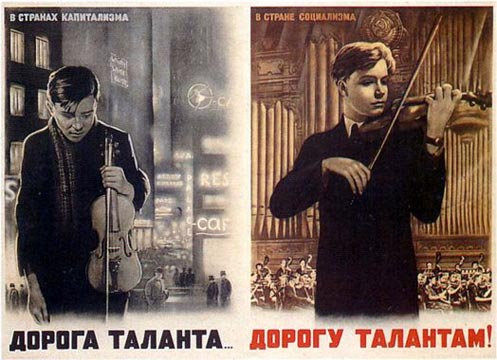
The Tate Modern currently has an exhibition of Soviet era propaganda posters.  I spent a lot of time looking at them, but here is the one that sticks the most in my mind:

"Road to Talent"

On the left, we are shown a (presumably) talented violinist in the U.S., cold, poor, and hungry, wandering the streets at night and being unable to make a living from his music.  On the right, we see a similar violinist in the U.S.S.R., his skills being properly nurtured by the state, elegantly dressed, performing with an orchestra.  Of course, what the poster doesn’t show are any of the drawbacks of the state-sponsored system. 

My husband told me this poster wasn’t so far off the mark.  Many Soviet-trained musicians immigrated to Israel and it was common to see these world-class musicians busking on the streets.  There were simply not enough orchestra seats in the country to accommodate all of the incoming talent.

This got me thinking about the price we pay, as artists, for our art.  When does the price become too high?  Although in some ways the Soviet Union was ideal for artists, many were stifled: denied religious, sexual, or political freedom, not allowed to manage their own careers, censored.  For some musicians, it was obviously better to be busking in Israel than having a glamorous concert career back home.

Here is the U.S. the price for artists is very different.  There is the money/time trade-off: do you get a day job for money and then run low on time, or do you take the time for your art and embrace possible financial insecurity?  Can you achieve the dream of being successful enough to have both time and money?  Or can you find a compromise between the two like I did?  There is the rejection price: lots of hard work, often for years, with very little recognition or reward beyond that of the creation itself.  There is the voice of public opinion, wondering at the value of what you do, telling you that you’re wasting your time, confused as to why it’s taking you so long to become “famous”.  There is the pedestal-pit price of everyone either telling you how what you do is impossible (“I could never sing”) or how what you do is so simple (“I’ve always thought I could write a book”), to the point that it becomes hard to explain that art is rarely either impossible or simple, consisting mostly of a lot of hard work.

American artists complain about all these prices a lot, and that’s fine.  We’re letting off steam so we can go back and focus on our work.  Or we’re commiserating with one another.  Or we’re educating the public and trying to change the necessary prices.  But overall, I think we’re lucky.  I can write a book including controversial interpretations of American history or compose an opera on the evils of capitalism, and I won’t be thrown in jail.   I can believe what I want and talk about it ad nauseam on my publicly accessible blog.

Sure, the price can still become quite a hardship sometimes.  But we all have a choice about what priorities we’ll set, and we can even change our minds later on if it’s not working out the way we hoped.  I’ll choose the life of that violinist wandering around in the dark every time.  The confusion in the dark makes the art even more valuable in my eyes.

Read Full Post »

I don’t have pierced ears.  Where I live, it’s fairly unusual for a woman not to have pierced ears.  Plus I grew up in a time when people pierced other body parts to show their nonconformity.  (Or maybe to look sexy or funky or on the edge.  I’m not sure since I never did it.)  It’s the rare occasion when I meet another woman without basic ear piercings.

It’s not that I don’t like jewelry.  I actually have a weak spot for jewelry.  I wear necklaces, rings, the occasional bracelet or anklet.  I love shiny sparkly stuff, and I love how artistic jewelry can be.  I look at beautiful earrings in little boutiques and covet them.

People ask me if I don’t have pierced ears because I’m afraid of the pain.  While it’s true that I hate pain, that’s not really the reason.  I wasn’t allowed to get my ears pierced as a kid, but I could have done it when I was twelve or thirteen.  Only by then it was too late.  Without even knowing it, I had already grown up into a closet nonconformist.

I thought about getting holes punched in my ears, and then I thought about what a weird idea that actually was, punching holes in your body just so you could display a little more bling.  Suddenly ear piercings didn’t seem ordinary anymore.  They seemed like a barbaric custom of some foreign tribe.

Now please don’t get me wrong.  When I look at other people’s pierced ears, I don’t feel shock or horror or condescension.  I don’t actually think piercing is a barbaric custom.  It’s more that, once I thought of that point of view, I could never look on the custom the same way myself.  It’s been twenty years, and I’ve never found any reason to change my original decision.  I’ll keep my ears the way they came, at least until I have a provocative reason to do otherwise.

So what do you think?  Am I stubborn or an original thinker (or both)?  Either way, my lack of pierced ears is one of my tells, revealing that I am a free spirit.

Read Full Post »

Looking at the title of my blog, I began to wonder what a free spirit is, exactly.  I know the stereotype in the movies: Summer from (500) Days of Summer, or Sharon Stone’s character in The Muse, or Clementine from Eternal Sunshine of the Spotless Mind.  I’m not really like any of those women though, so there’s got to be more to it, right?  (Also, what about the free spirit men?  Why can’t I think of any movies about them?  Help me out in the comments, please.)

I turned to the internets to help me out.  Apparently, a free spirit is someone who is not restrained, for instance by convention or obligation.  Or it’s someone who has a highly individual or unique attitude, lifestyle, or imagination.  Or it’s someone acting freely or even irresponsibly (I guess that’s where the practical part of my blog title comes in?)  All the definitions agree on one synonym to describe a free spirit: nonconformist.

Oh, right.  Thank you, dictionaries everywhere, for reminding me what I’m talking about.

Here’s my definition of what it means to be a free spirit:

  • A free spirit thinks for himself, observing and collecting data in order to form his own opinions.
  • A free spirit does what she thinks is right, not what everyone else tells her is right.  She puts a high value on free choice.
  • A free spirit cares about getting to know both himself and the world around him.
  • A free spirit isn’t generally swayed by arguments of what one is “supposed” to do.  She tends to avoid, ignore, or become upset by people who are judgmental or controlling.
  • A free spirit has the courage to test life’s boundaries and limits, and to try things that other people think are impossible, unimportant, or impractical.  (These other people are often wrong.)
  • A free spirit often has her own unique vision of life and the world.

This does not mean a free spirit is a trampler, i.e. the kind of person who doesn’t care about other people’s feelings.  Nor are all free spirits incapable of compromise and discussion.  They aren’t inherently flighty or irresponsible or train wrecks on wheels.  Free spirits can be any of these things, just like everyone else, but they don’t have to be.

I also suspect there are those to whom free spiritedness comes easy, and those for whom it’s very difficult.  Or maybe there are just people like me who swing back and forth between the ease and the struggle.  There are noisy free spirits and quiet free spirits, extroverts and introverts and ambiverts, free spirits who engage in risqué behavior and those who think risqué is passé and so go to the other extreme.  (Ask me sometime why my ears aren’t pierced and you’ll see what I mean.)  Some of us are stubborn while others are fickle, some of us are dedicated while others drift from thing to thing.  We can be challenging, yes, and difficult to understand, but we love life with a passion that makes it all seem worthwhile.

Whatever our shortcomings, we make the world a more varied and interesting place.  We are agents of change and opponents of inertia.  As Arthur O’Shaughnessy, a 19th century British poet, said:

We are the music makers, and we are the dreamers of dreams.


Read Full Post »

voting guide

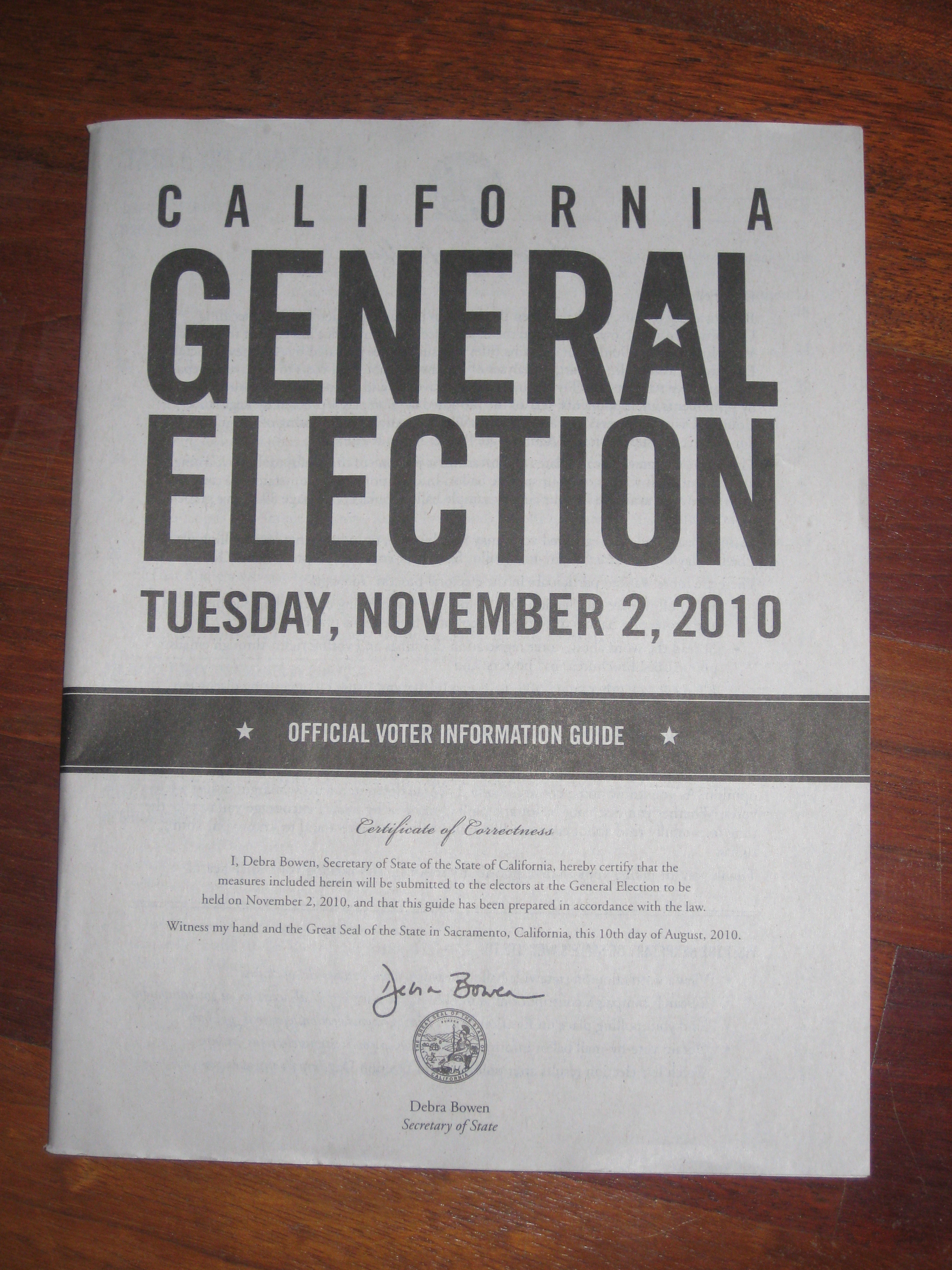
It’s that time again: election time.  I recently received my California General Election information guide in the mail, along with my absentee ballot (I’m on the permanent absentee ballot list because I find it encourages me to vote).  And once more I prepare to climb into the morass of trying to figure out who and what to vote for, which involves trying to find information about people I’ve never heard of and wading through dense legalese.

Some quick statistics, based on numbers I found here and here.  California has an estimated 18-and-over population of 27.7 million.  As of April of this year, there were 16.9 million registered voters in the state.  Some easy math tells us that only about 61% of those over 18 are even registered to vote (leaving over 10 million adults in the dust).  And of course, just because someone is registered doesn’t mean they’ll actually cast a vote in any particular election.

Voting is very important to me.  I feel lucky to have the chance to participate in my government and to have duties as a citizen.  But when I’m faced with my 127-page information guide (which does come in languages besides English, I am happy to say, although how easy it is to obtain one in the correct language is outside of my experience), I’m not so shocked that only sixty percent of those eligible elect to participate (or even have the possibility of participation).  In fact, I’m surprised it’s that many.

(By the way, my actual ballot is printed in both English and Spanish.  Good move, whoever is in charge of such things.)

It takes a lot of time for me to vote, and it causes me a fair amount of anxiety.  I read the text of each proposition carefully, trying to understand what it actually says, and I usually pop on the internet and have a look at the opinions of a few established groups.  And then I hope I’m actually understanding something outside of my expertise and cast my vote.  In this year’s election, I will go through this process ten times, once for each proposition.

And then there are the elections for mysterious positions such as State Controller, Insurance Commissioner, Board of Equalization members, and Water District Director.  (Thank goodness my handy guide tells me what these positions are because otherwise I might not know.)  Meanwhile, I’m just feeling relief that there don’t seem to be any local elections this time around, with all kinds of City Council members, Judges, and assorted bureaucrats who aren’t even associated with political parties in case I need to fall back on blind party voting. (EDIT: Oh no, wait, there are City Council members up this year.  Sigh.)

Then there’s the propaganda problem.  Thankfully I don’t watch TV so at least I miss the commercials, but when digging through available information, how do I know who to believe?  And while I’m willing to dig through the voting records of presidential candidates (during primary time, since by the final election I only have two choices anyway), do I really have time to do so for every single candidate on the ballot?  Hmm.

So I muddle through the ballot, doing my best to make responsible, informed decisions and sometimes falling short.  If I weren’t so personally invested in my voting rights, I could see getting lazy and just not bothering with the whole thing, since it often results in my feeling helpless and/or stupid.  Yet another instance in which my stubbornness comes in handy, forcing me to do the right thing.

Because voting is the right thing.  No matter how unpleasant or confusing, no matter how complicated or mysterious, casting my vote is a concrete action in the face of widespread apathy and ignorance.  It says that I care about my country, I care about my fellow citizens, and I care about my hard-earned right to have a say.  It says that I’m not taking the status quo for granted.  It says that I believe each one of us is involved in creating the world we live in.

Are you planning to vote in November? If not, I hope you consider changing your mind and joining me in the baffling yet important process of participating in our government.

Read Full Post »

Yom Kippur begins at sundown tomorrow.  I don’t have an intimate viewpoint on this holiday, not being Jewish myself and having never attended synagogue on this High Holiday.  I’m pretty far from being an expert, so what I’m offering is an outsider’s perspective on what this holiday has come to mean to me.

For years, all I knew about Yom Kippur was that it was a name on the calendar.  When I first learned a little more about it, I didn’t get it at all.  Fasting all day, droning in a foreign language, lots of tears and catharsis.  It was so different from any other holiday I knew about, I even found it a touch creepy.  As the years have gone by, however, my feelings have undergone a profound shift.  While I don’t celebrate it myself, I love this holiday and what it stands for.  It is also known as the Day of Atonement, and I have deep respect for a religion that has set aside an entire day for this type of introspection.

Where have I gone wrong this past year?  Who have I knowingly or perhaps unknowingly injured?  What could I have handled more skillfully?  To me, this process of reviewing the mistakes and hurts of the past year (whether intentional or not, avoidable or not) celebrates what it is to be human.  We all make mistakes, we all handle things badly, we all say things we shouldn’t have said, or leave things unsaid that we shouldn’t have.  We forget or unable to keep important promises; we tell lies, perhaps to avoid even greater conflict; we don’t have the time or energy or capability to be there the way we wish we could.  We make other people cry; we lose friends through change, neglect, or direct confrontation; we make the wrong decision.  And here’s this holiday that acknowledges this reality we live with, that says: Yes, it’s true, none of us is perfect, and yet we can always strive to improve ourselves, to move on and do better next time.

The way I see it, the process of atonement has three steps.

Step 1: Be aware of your effect on the world. Think about the actions you have taken, the mistakes you have made, how you’ve treated other people.  Reflect on questions of morality.  Remember those times you let your emotions get the better of you.

Step 2: Feel the emotions associated with your actions, and then forgive yourself and let go. This is a hard step, and a critical one.  Atonement isn’t about self-hatred; that will only make your behavior worse over time, not to mention erode at your happiness and well-being.  Atonement is taking responsibility for yourself and your choices, while remembering that you are human and imperfect.  By the end of Yom Kippur, a practicing Jew is considered to be absolved by God.  However, if you don’t believe in a God to be absolved by, you need to find the strength to forgive yourself instead.

Step 3: Learn from your previous behavior and mistakes. Having taken the time to introspect so deeply about your behavior, you can move through life with a cleaner slate.  Not a blank one, of course, but at least a less messy one.  Take the time to think of possible solutions for some of your mistakes.  Sometimes there won’t be a solution, and that’s okay too, but at least you’ll know one way or the other.  Think of how you can become more like the ideal person you wish you were.  Will you ever really become that person?  Perhaps not, but I like to think that throughout life, we draw ever closer to realizing our full potential, as long as we have the willingness to learn from our experience.

I love Yom Kippur because it’s a formalized ritual that helps people go through these steps with the full support of a community behind them.  It means they don’t have to face their faults and shortcomings alone, but can remember that everyone else is in the same boat.

So whether you’re Jewish or not, whether you’re religious or not, I hope that’s what you take away from this post.  We all make mistakes, and it’s important to be aware of them and learn from them.  But we’re also all in this soup of humanity together, capable of learning from what has passed before.

As Anne in L.M. Montgomerie’s Anne of Green Gables says, “Isn’t it nice to think that tomorrow is a new day with no mistakes in it yet?”

Read Full Post »

E-books and the Apocalypse

I am the semi-satisfied owner of a Kindle (semi-satisfied because the DRM still creeps me out) and in general, I’m a fan of electronic books.  I’m also a fan of hardbacks, mass paperbacks, trade paperbacks, super deluxe special editions… basically I’m an all-around kind of book fan.

But I do have one worry about electronic books that no one ever seems to talk about: what possible disastrous effect will electronic books have on the store of human knowledge, art, and entertainment in the event of an apocalypse?

I know this is illogical.  I know that books printed on paper are vulnerable to all kinds of destruction: fire, flood, crumbling to pieces due to old age, complete inaccessibility due to building collapse, toxic waste, control of written material by a tyrannical minority, etc.  So electronic books don’t have the monopoly on tragic loss.  But still, think of the possibilities.

First, on a personal level.  If you were living through a Lost scenario (plane crash onto isolated island, no rescue in sight), your e-reader would die within … a couple weeks, maybe?  If you were lucky and it didn’t suffer unfixable damage.  Wouldn’t you rather have a few paperbacks that would last your entire exile?  Not only could you read those books again and again (and out loud to your fellow strandees as well), if you had a pen, you could write *new* stories in the margins and end pages, thereby giving you more reading material.

Or what if the power was off in your house for a week or more?  (This actually happens in real life even without an apocalypse.)  And let’s say you’ve been lazy about keeping your e-reader up to full power (this also actually happens in real life).  So once it gets dark, you decide to read with your flashlight, since you can’t watch movies or TV, you can’t play piano because it’s too hard to read the sheet music in the dark, you can’t call anyone because your cell phone is running out of charge and you’re preserving it for an emergency.  But then you can’t read either because your Kindle is dead!  Meaning you’ll have to find a coffee shop that allows you to mooch off power (or hope the power isn’t off at your office as well, if you are fortunate enough to have one of those).  Or you’ll be stuck whispering ghost stories in the dark.

Or what if, twenty years from now, Amazon goes out of business?  And what if there are problems, possibly due to the stupid DRM, with porting your library, now possibly numbering in the thousands of titles (definitely at least hundreds), over to whatever alternate e-reader is dominant at the time?  (If there is an alternate and Amazon doesn’t go under in a general economic collapse.)  You may scoff and say how unlikely this is, but having just read Ted Chiang’s The Lifecycle of Software Objects (which I highly recommend even if I think it should have been a novel instead of a novella), you never know.  (Note: this is especially true if you are the kind of person who daydreams about apocalypses.)  After all, what good do all those old 5.25 floppy disk backups do me today?  I can’t look at any of my old papers or stories for reference anymore unless I happen to locate a hard copy.

Now, expand out to a societal level.  My favorite apocalypses to ponder these days are generally related to global warming and/or running out of oil and/or some political excitement.


A retreating glacier

(Sorry, I don’t do zombies.)  Now, if I’m feeling optimistic about these scenarios, I can hope that by the time trouble strikes, solar power has become more widespread (or wind, or water) or some other practical energy source has been developed.  But will the infrastructure be in place so there isn’t even a blip when switching over the electricity grid?  Will there be enough electricity all the time so people can spare the amount it takes to charge an e-reader instead of, say, run lab or farming equipment or a water heater or power a hospital?  Now if you owned physical books, on the other hand, your only problem would be lack of time in daylight to read them, and if you could figure out how to make candles, well then, problem solved.  (Now an e-book with built in solar energy panels could be cool, but what if the panels break?  Would spare parts be available?  Would I have or be able to purchase the expertise to use said spare parts?)

Whenever I plan my ideal supplies for surviving post-apocalypse, I always include as many reference books as possible (unless, of course, I have to be mobile in said apocalypse world, which severely limits the books you can carry).  There are so many basic things that modern life has left me unprepared to face: making candles is a great example.  Making soap, medical and first aid techniques, mechanical crash courses for as many devices as possible, farming and gardening, how to gut a fish or deal with a live chicken if I want to eat it.  The knowledge I don’t have that would be necessary for survival goes on and on.  Maybe I’ll be lucky and live in a community with experts on various of these topics, but what if I don’t?  I’ll have to rely on the reference books.

And I’m not even getting into the dream of preserving human knowledge and art (Shakespeare, anyone?) for future generations.

What this all boils down to is that I’m unlikely to give up my physical library any time soon.  Call me old-fashioned in ten years or twenty, and I’ll probably cheerfully agree with you.  But if the apocalypse comes, I’ll have the last laugh.

Read Full Post »

Tomorrow I head off into the great beyond of Los Angeles to attend SCBWI’s annual summer conference and inundate myself in all things kidlit.  To my knowledge, I know one other person attending.  Happily, this lack of acquaintance doesn’t bother me because I can rest assured in the knowledge that as a group, kidlit writers have to be some of the warmest and supportive people in existence.  I also have the happy past experience of the winter conference to bolster me.  In my experience, starting a conversation with someone with a shared and consuming interest like writing is not generally a difficult accomplishment.

However, this leads me to one of my recent subjects of interest: namely, the art of conversation.  I’m not talking about the skill of small talk, which while useful, isn’t that thrilling for me.  I’m also not talking about the art of debate, which can be interesting, but only if the debaters (or at the very least, me as their audience) aren’t completely and finally wedded to every last detail of their opinions.  No, I’m thinking about the art of interesting conversation.  You know, when you’re talking to someone and you feel you could just keep talking for hours?  Or when someone says something and it actually requires you to (gasp) stop and think?  That kind of conversation.

One of the main barriers I notice to achieving such a level of worded bliss is the question problem, which goes both ways. First and most simply, it’s been my observation that a lot of people don’t ask enough questions.  Questions have interest built-in because they include the supposition that there is more than one possible answer (otherwise, why are you asking?)  They also show a pleasing desire to get to know the conversational partner and place value on said partner’s opinions, which develops rapport.  A well-asked question can be the instigator of a lively discussion in which the people involved might actually learn something, help each other come up with new ideas, or be exposed to a different point of view.  Alternately, questions can encourage a friend to talk about something challenging or exciting in their lives that they might not otherwise have felt comfortable discussing.

On the other side of the equation, people don’t always encourage good questions with their responses.  If I offer an opening question or two and receive only monosyllables or replies designed to shut me down, I am left high and dry without any hooks to continue the conversation or discover what that hidden gem of a question might be.  In the same way, if the answers to questions aren’t approached in a thoughtful manner, it is much less likely that there will be any part of the answer worth pursuing.  And don’t even get me started on the monologue problem.

The ideal conversation requires all people involved to do some heavy lifting.  Without mutual questioning, the talk turns into a parody of an interview.  Without actively listening to your conversational partner’s points, it is difficult to be affected by the conversation or to respond in a genuine and engaged way.  Without the willingness to realize your own knowledge may be limited (or even wrong!) or another point of view might offer valuable ideas and perspectives, what’s going on isn’t a conversation so much as a two-sided internal monologue spoken aloud.

The point of conversation is to both entertain and engage (and possibly to educate, although this one is dangerous as it can lead to pomposity).  This means, among other things, making an effort to keep track of who you’ve told what funny stories in the past.  Or at the very least, for those with poor memories, you can ask your potential audience if you’ve already told them about that time in Cairo, thereby allowing them a graceful exit.  It means asking others for their opinions instead of merely expounding on your own.  It means choosing conversational topics that include all people participating – so for example, maybe you shouldn’t speak too long about a role-playing game with a group that includes one or two people who didn’t play the game, or maybe you shouldn’t have deep technical-speak shop talk with a group that includes someone who isn’t part of your field.  (Yes, I live in Silicon Valley, can you tell?)  This is not to say that you can’t talk about subjects relating to your career and/or passions (my husband and I talk about various writing, scientific, music, and computer-related topics all the time), but it does help to gear them towards a non-specialist audience when appropriate.

I firmly believe that good conversation is an art, and an art that I need to continually consider and practice.  So tell me, dear readers, what do you look for in a satisfying conversation?  What are your favorite conversational moments or pet peeves?  Let’s talk about talking, shall we?

Read Full Post »

Lo and behold, I announce a themed week about creativity, and one of my favorite bloggers, Justine Musk, comes out with a post all about thinking creatively today.  Ask and ye shall receive?  Go check it out!

Read Full Post »

« Newer Posts - Older Posts »