Feeds:
Posts
Comments

Archive for the ‘Society’ Category

People like to find a scapegoat.

Recent articles link the rise of loneliness in modern society with the use of social media, and although I have explored the idea before, I have become less convinced. Isn’t it convenient that we can blame technology, that behemoth with which we traditionally have an uneasy relationship, for the lack of connection we might feel? And yet, even if, as some figures suggest, Americans are now lonelier and have fewer confidants than in the past, there is still little data to show this trend is being caused by social media.

I agree with Dr. Grohol, who states: “[Using social media] doesn’t stop me from having those in-depth, face-to-face conversations, or put them off. I’m under no illusion (or delusion) that having a social networking circle of hundreds or thousands makes me more social.”

Instead, what social media allows us to do is maintain, in unprecedented volume and frequency, our weak ties. What is a weak tie? Someone who we don’t know very well, an acquaintance, if you will. By fostering so many weak ties, we are able to continue to expand our social networks and have potential reach to larger numbers of people, many of whom we will never directly meet or communicate with.

Obviously this is a major boon when we are, say, trying to sell something or build a reputation for ourselves or looking for a different job. But it can also be valuable because of the different insights and opinions we are exposed to, the potential actual friends we might meet, and the recommendations we might receive. Not to mention the benefits of being able to keep in touch, however superficially, with friends and family who live far away.

However, it’s not hard to see how social media might appear to make us lonely, especially if used as a kind of social substitute that it isn’t. If I am already feeling lonely and then I hop onto Facebook, the odds that spending half an hour reading my “friends’” status messages will make me feel any better are fairly low. But I have noticed a certain irrational expectation in myself that seeing all those photos and clicking “Like” a few times will magically pick up my spirits. Note to future self: that doesn’t work! Go out and see someone instead.

It’s interesting to watch ourselves learning how to deal with so many weak ties at once, a feat about which we are only now gaining experience. I like to think of social media as a party: a few of your really good friends are there, which is especially awesome. Then there’s those people who you’ve been seeing at these parties for years, and that’s the only time you talk to them. And there’s the newcomers, the people you don’t know so well but it’s interesting to chat with them for a few minutes. Except this is happening all the time on your computer, not just for three or four hours at a scheduled event.

And just like at a party, most people are trying to present their best selves. Many of them will keep their dirty laundry and deeper troubles mostly under wraps. A few of them might have embarrassingly public meltdowns. We’re surprised when  the perfect married couple announces their impending divorce, when that vibrant woman turns out to have been suffering from a life-threatening disease, when bits and pieces of messy life burst unavoidably out into public view.

And social media is very much the same. We are presented with a smooth and managed facade, and sometimes we forget the facade does not always reflect what’s going on under the surface. All those people in your social media networks who have perfect lives with adorable children and exciting jobs and exotic vacations? Maybe her child vomited all over the living room this morning, or that exciting company is going through a round of layoffs, or that exotic vacation meant forty-eight hours of pure, unadulterated suffering from food poisoning. Some people show this underbelly of their lives, but many choose not to. It’s the way weak ties work. And as depressing as all this seeming perfection can occasionally be, we mostly find it depressing because we are not used to weak ties; we haven’t internalized the knowledge that these public statuses are only a small percentage of the whole. We believe, often without question, the stories people choose to tell about themselves.

The societal shift we are experiencing is certainly not without its difficulties. But social media, and the internet as a whole, are just technological tools like all other such tools. Sometimes we use them skillfully, and sometimes we don’t. Sometimes we lack the understanding of how such tools work or for what they work best. Sometimes we’re not very interested in trying them out at all.

But I suspect loneliness arises much more from our physical environments and the strong ties that we either have or don’t have with other people. Strong ties that are fostered by face-to-face interaction, video chat, phone calls, and the exchange of letters and emails. Blaming a tool meant for developing weak ties for any trouble with strong ties seems misguided at best.

What do you think? Do you have less in-person conversations or strong ties because of the advent of social media? Have you been able to develop strong ties as well as weak ties through a social media service? How much does face-to-face time matter in your close relationships?

Read Full Post »

Okay, no, not really. What I really want to do is talk about ambition and different definitions of success.

I talk a lot about priorities, and ultimately our priorities hinge on our own personal definitions of success. In order to set priorities that work for you, you have to know what you want. Sometimes this directive becomes more complicated than it sounds.

We have ideas imbedded by our culture as to what constitutes success, and there are different degrees of success as well. Money, power, recognition, advancement, and a stable career are all possibilities we recognize and mark as successful. In the personal realm, success is often associated with being a spouse, a parent, and a homeowner.

Of course, we can hit our own personal mark of success without ever having a lot of money, or a lot of power in the business world, or the same steady job for twenty-five years. Success is subjective. Our definitions of it change over time. And yet, we are often influenced by the cultural ethos of what success means.

Dr. Horrible has his own unique definition of success...

Ambition gets all twisted up in these definitions as well. When we are going for what we want, pursuing our own success, then we are being ambitious, but we often limit our thinking about ambition to apply only to career-related goals.

For me, success has never been so much about money as it has been about being able to spend my time on things I find valuable and fulfilling. This is why I have, in the past, chosen time to do what I choose over more money. Some of the things I find valuable and fulfilling involve the outside world: teaching, for example, and helping people. Some creative endeavors might or might not reach the outside world. And some things I find of real inherent value even though they are just for me.

We as a culture also tend to buy into the idea that success will cause happiness. Sometimes this works out; when we figure out what will actually make us happy and prioritize accordingly, happiness and success can come hand in hand. But sometimes we assume success will bring us happiness without figuring out what would make us happy in the first place, only to suffer a rude awakening and realize we’re caught in a cycle of always wanting more: if only I had a bigger house, if only I made senior VP, if only I made #1 on the NYT bestseller list. Finding happiness within achievement without getting trapped in what we haven’t yet achieved can be an uneasy balance.

There are no right answers here; we have to make individual decisions about what’s important and how to define success for ourselves. We have to discover what it is that brings us happiness and personal satisfaction. And if the answer doesn’t meet the cultural norm, then we have to decide what we care about more: following the marked, tried-and-true road map to find success in other people’s eyes or venturing off the beaten path and making our own way. Either choice comes with its own difficulties.

What does success mean to you? Do you consider yourself to be ambitious?


Read Full Post »

On Tuesday I read a blog post in which a female blogger made a list of people in her acquaintance she’d put in charge of governing society if she was a monarch. All the people on her list were male. When called on this fact in the comments, she mentioned one woman she knew who she felt was “awesome,” but then proceeded to say she’d listed people she knew who were “wicked smart” and that offhand, she couldn’t think of any other women she’d put in that category.

Typing that just now makes me want to yell and scream and possibly hurt my foot by kicking something unexpectedly hard.

As a woman who is “wicked smart,” let me explain something to those of you who haven’t thought about such things. High-IQ women often do not present in the same way as high-IQ men. That doesn’t mean they’re not just as smart; they just behave differently, in ways that are not typically identified with high intelligence.

For starters, smart women often work very hard to fit in. We blend. We spend a lot of time listening to other people talk. We don’t always put ourselves forward, even when we have expertise or insight about a certain topic. We are not as likely to offer or even form opinions, since we are supposed to be nice and agreeable. We are not as likely to argue. We deliberately choose topics of conversation that don’t show off our intelligence, partly because being an intelligent woman is somewhat fraught in our society and partly because if we want to have a real conversation instead of expound, it often works better to choose a topic in which intelligence doesn’t matter as much. We do much of this unconsciously because it tends to get us better social results, ie people like us more.

Women in general are also not encouraged to be as ambitious as men. We get more flak about being ambitious. People patronize us and tell us we have delusions of grandeur. In many professional arenas, we have to adopt masculine behaviors in order to realize our ambitions, not to mention deal with sexism. We also have to do better than men at the same positions in order to be recognized. And then people will minimize our accomplishments and say catty things about our appearances and personalities. Not to mention, women who want to have kids know they’ll end up with more of the work involved, even if they have full-time careers as well. So high-IQ men are often very “successful;” they might be wealthy or have a fast-track career or a top-notch reputation in academia. High-IQ women don’t always have any of these things because we either chose not to follow ambition in the classic sense or because we felt we should not.

Finally, our society privileges the sciences over the humanities and the arts, and factual knowledge over both raw intelligence (which is more about speed and ability to learn, understand, and synthesize) and emotional/social intelligence. And yet, women are less likely to go into the sciences, less likely to offer up their knowledge in conversation, and more likely to be encouraged to focus on emotional intelligence. And for those of us who have focused  on synthesis as opposed to factual memorization, our talents are often entirely overlooked.

The secret land of intelligent women?

My husband and I are a great example of this. By both our assessments, we are more or less equally intelligent. He has a PhD in physics, an important job at Google, and impressive amounts of knowledge on a variety of intellectual subjects. I’ve spent most my time pursuing music and writing and focusing on personal growth and interpersonal issues. It is not uncommon for people to tell me my husband is one of the most intelligent people they’ve ever met. No one ever tells him the same thing about me. He presents himself very differently in social situations, has many of the expected achievements, and studied string theory instead of music, so this doesn’t come as a big surprise.

I didn’t want to talk about this subject because we as a society seem to have a deep discomfort with intelligent women, and talking about it leaves an opening to be personally attacked or categorized as stuck up. I can hear it now: “She’s not as intelligent as she thinks she is, and her husband is just playing up to her big ego.” Admitting to intelligence, at least here in the United States, is not the best way for a woman to gain friends and influence people. And ironically, gifted people tend to be more sensitive, more likely to be perfectionists, and more likely to hold themselves to impossibly high standards…all while suffering from impostor syndrome. But I’m so tired of the misconceptions that abound, and I don’t hear enough women speaking out on this subject, so I felt I had to say something.

There are plenty of very smart women in the world. You might just not realize who they are. So the next time you are listing off smart people you know, think again and consider whether you can add some women to your list.

Read Full Post »

Our notions of privacy are currently changing due to technology, and it’s an interesting time if you enjoy watching social trends. For example, head on over to Nathan Bransford’s blog and read his fascinating essay “Divorce in the Internet Era.” He gives us an intimate peek into how the experience of divorce has been changed by social media.

It’s not just divorce that has been affected. Social media has also transformed our ideas of social connection, of friendship, of the purpose and maintenance of strong ties vs. weak ties (ie acquaintances and people we met that one time–when was that?–and in a flash of enthusiasm connected on social media). It has affected how we do business, how we try to connect with a more specific audience, how we can succeed at marketing, and how we can fail. It has spawned the 1000 true fans theory.

And now with the announcement of Google Goggles (known officially as Project Glass), we see another potential radical social change: a world in which our goggles tell us everyone’s names and pertinent information when we meet. A world in which remembering names is less important. A world in which I can make notes for instant reference the next time we meet: “possible kindred spirit” or “didn’t bother to ask me a single question during a thirty-minute conversation” or “really likes discussing neuroscience but becomes enraged at the suggestion that humans don’t have free will.”

My own personal ideas of privacy have changed along with the times. Every time I post on the Internet, whether that be here on the blog or on the myriad of services I am encouraged to use, I try to remember to run a little filter check. If the whole world knows I said this, would I be okay with that? If the answer is yes, I’m good to go. And every time I remember to run this check (which probably isn’t 100% of the time because no one is perfect), I develop and refine my ideas about my own privacy, about what I’m willing to share as public information vs. what I wish to remain private. In a certain way, our society is shifting back to a village mentality, that there are certain things that everyone simply knows about everyone else. And anything we want to keep to ourselves, well, we have to really work at it…and some facts, as Nathan Bransford found, are impossible to keep under wraps.

I’m hoping this shift will come with a lessening of certain stigmas and an increased tolerance for difference. I have to hope for this because the alternative is not a world in which I want to live. Perhaps we’re already seeing evidence of this shift: contrast the open statements about President George W. Bush’s past alcoholism and President Obama’s past cocaine use with President Clinton in the ‘90s who felt it was necessary to claim he “didn’t inhale.”

On Twitter, Catherynne Valente said, “The Google Goggles herald the final death of any semblance of public manners and social courtesy. Hope we enjoyed it!” But I wonder if all these changes might eventually lead to a new kind of civility. Will there be certain secrets we allow each other to keep out of sheer politeness? In a world where everyone knows each others’ names, will our sense of community change? Maybe even expand? What kind of courtesy will be possible when we can have a computer keep track of our acquaintances’ interests and news and automatically remind us of them when we’re in conversation? Will intimacy feel like it’s shrinking (the way some people feel social media is causing it to do right now) or will it feel like it’s increasing?

It’s going to be really interesting to find out! The one thing I’m betting on is that we’ll have a bumpy transition as what is possible from technology changes at a different rate from society’s attitudes about privacy and social interaction. What do you think? What about this new world do you look at with dread? What about it sounds like it could be amazing?

Read Full Post »

I’ve been reading Bill Bryson’s most recent book, At Home, which I wanted for months and then received for Christmas (and even then, it took me another couple of months to get to it, which goes to show how out-of-control my to-read stack has gotten). Its subtitle is “A Short History of Private Life,” and its chapters are named by rooms of the house. Bill Bryson’s 19th century former rectory house, to be precise.

This is what my book looks like.

I thought the book was going to be full of anecdotes about each of the rooms: what activities were typically performed there, how those varied over time, how each would be furnished, etc. And there certainly is plenty of this information in there, but that’s only a beginning. With his typical charm, Bill Bryson supplies bucketfuls of mostly random (but still fascinating) facts that are often only tied to the room in question by the loosest of associations:

  • the building of the Crystal Palace for the Great Exhibition of 1851
  • the usefulness of bats as a species and how many are now in danger of extinction because of rabies myths
  • the building of the Eiffel Tower and how it is constructed of iron, not steel
  • how ice became a commodity
  • how very dark it used to be at night, and various techniques of lighting

Although I like this cover art better!

My main take-away from the book is that it really sucked to live in the West after the Roman Empire and before the twentieth century. It was dark and painful and exhausting and dirty, full of back-breaking daily labor for almost everyone. People would get sick all the time, sometimes even from the chemicals they used in the wallpaper and paint on their walls, and there was no anesthetic. Rats and mice would scurry over your bed, especially if you were a child sleeping in a trundle bed. And if you didn’t want your loved one’s body stolen by grave robbers, you had to keep it in your house until it went bad and began producing maggots. Yuck.

As a woman, it sucked even more. You either had to perform repetitive back-breaking labor (like laundry, which also involved chemicals that made people sick) or, if you were lucky, you had to sit around and be bored out of your mind while preserving your delicate sensibilities. Thank goodness music and art were considered appropriate activities for woman, but heaven forbid you read a novel. You were considered property and in England, at least, it could be quite difficult to get a divorce. Beating was commonplace and no grounds for leaving; it merely showed you lacked sufficient patience. Doctors would often dismiss your medical complaints because you were a woman. And you’d probably end up dying in childbirth anyway.

I am even more grateful than usual to be living now, in an age of antibiotics, safer childbirth, labor-saving devices, electricity, and more opportunities for women. If I could choose any time period to live in, which would I pick? I’d pick NOW, thank you very much. I like having teeth and the right to vote.

In any case, it’s a great book and I recommend it. And now I have to ask: if you could choose any time period to live in, which would you pick?

Read Full Post »

As many of you know, I’m a big Buffy the Vampire Slayer fan. I’ve watched the series more than once. I have a Buffy T-shirt. I even own a replica scythe. So what I’m about to say may shock you.

Buffy the Vampire Slayer is not a feminist show. It is sometimes egregiously sexist, in fact. It showcases repeatedly negative portrayals of female sexuality and engages in blame-placing on female characters (Buffy is accused of leading Spike on, Buffy is blamed for Jenny Calendar’s death even though Angel is the one who did it, etc.) while excusing crazy behavior of male characters (Buffy should obviously instantly forgive Riley for cheating on her with vampire women). There’s the problematic treatment of dismissing rape in Season 7. And I could go on.

However, I strongly disagree with the idea that Buffy is not a strong female character. Indeed, I’ve begun to worry about our culture’s definition of what a strong female character actually is. Yes, we obviously want to get beyond the idea that a strong woman is simply a man with boobs–what a ridiculously simplified idea. But I’ve been seeing some commentary that suggests that strong female characters still have to be…well, perfect and together and always making the right decision. And heaven forbid they ever show emotion or, you know, CRY.

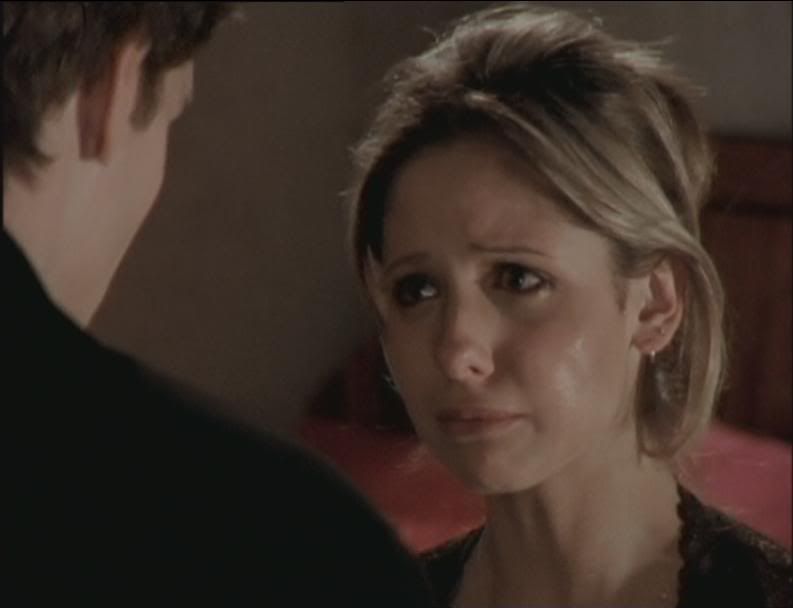
Is Buffy a strong female character?

I’m going to unpack a few of these ideas in relation to Buffy so you can see what I mean. First up is Mur Lafferty’s critique of Buffy the character. (I actually agree with much of this article, especially the part about The Princess Bride, which is an awesome movie if you ignore the horrible female characters and particularly the passive MacGuffin who is Princess Buttercup.) “Buffy failed this test [of emotional strength] when Spike attacked her in Season… 5? Since the attack was sexual in nature, Buffy lost all ability to fight, and just struggled on the floor and cried…we’d seen her kill so many monsters – including her lover – I can’t believe she’d cave under that attack. It didn’t fit with the character.”

Okay, so the attempted rape scene in Season 6 is definitely an emotional moment. But that’s all it is: a moment. Buffy struggles against Spike and cries for all of fifty seconds before she succeeds in pushing him off her. (Yes, I timed it, just to be sure I was remembering correctly.) Not only that, but she does this while already badly injured, after dealing with several months of deep depression, and while dealing with the shock of having a former lover try to rape her. But her reaction time of fifty seconds, no, it’s just not quite good enough for her to be considered emotionally strong? Um… Yeah, it must be because she committed the cardinal sin of crying. (Not to mention this assessment smacks of victim blaming.)

Or does crying automatically make her weak?

Here’s another great one, this time from The Mary Sue (again, this article makes many great points but I quibble about the strong/weak character identifications): “And Buffy is textually weak in all her relationships. She falls apart not only when Angel leaves her, but when Parker (yeah, you don’t remember him, either) doesn’t want to pursue more than a one-night stand with her, too.” It goes on to discuss the badness of Buffy chasing after Riley when he flies off in the helicopter.

So does this mean a strong woman isn’t allowed to have feelings or make mistakes, even out of inexperience (as was the case with Parker)? I mean, are we just supposed to shrug after a painful break-up and decide not to care? After all, Buffy sends the vampire she loves to hell in order to save the world–not an act I’d call particularly weak. Sure, I wasn’t a fan of Buffy running after Riley, but she received bad advice from a trusted friend and had a moment of weakness. But I guess in order to be a strong woman she would have to recognize the sexist parameters of her world at all times and never have a second of doubt, disappointment, or grief… Or maybe it’s the crying.

From the same article: “And inherently problematic is the idea of the Watcher, a predominantly male presence that is the male gaze made manifest – a source of constant looking that is an explicit form of control.”

Yes, the idea of the Watcher is sexist. The origins of the Slayer are deeply problematic. But Buffy fights against this time and time again: she fires her Watcher, she rebels against the Council, she orders them to give her the information she needs about Glory, and at the end of the series, she thwarts their original intent for the Slayer by giving the power to all the Potentials. She is constantly second-guessed and undermined by everyone in her world, friends as much as foes, and yet she continues to fight and to believe in herself. How exactly is this not strong behavior? I really have no idea.

Strong female characters can still be human. They can be flawed, they can have moments of bad judgment, and they can cry. They can feel overwhelmed, and they can have bad taste in men. What they can’t be is only existing because of and judged in relationship to male characters. What they must have is some kind of personal agency. Even, and this is my key point, the agency to make mistakes and be less than perfect.

Rose Lemberg wrote an excellent article on feminist characters, and I really hope you go read the whole thing. She says:“But what we often do in genre is allow men to be uncomfortable and difficult, but erase the women who are less than warm and fuzzy-making.”

Yes. Even to the point of having unnecessarily limited definitions of what makes a strong woman. Buffy is a flawed character, but she exists in her own right, not as some kind of set piece for the male characters on the show and not only as a girlfriend, or friend, or sister, or protegé. She ultimately calls the shots and makes most of the hard decisions. And if anything, the facts that she suffers, that she feels loss and fear, that she cries, these things show how strong she really is.

So what do you think? How do you define strong female characters? And what are examples of them that you think are done well?

Read Full Post »

Disclaimer: This post in no way reflects the opinions of my husband or his employer. Yup, it’s one hundred percent me. So without further ado, here’s what I’ve learned from Google.

1. Filtering is critical.

Google is not a media company, and it doesn’t produce any content of its own. Its core idea is to filter and organize data in a way that makes it useful to the end-user (that’s you and me). Without a way to make sense of the huge masses of data, the internet would lose much of its practicality and all of its convenience. And when you think about, filtering is critical for communication in general. If you asked about my day and I gave you a minute-by-minute breakdown, you’d probably be so bored you’d miss anything important I chose to relay.

2. People will hate on you, and there’s nothing you can do about it.

No matter what decisions Google makes, some people are unhappy about them. I don’t even work there, and I hear about it all the time. The bigger and more successful you are, the larger a target you become for other people’s judgment and rage. (Seriously. Random people rage at my husband all the time. It drives me crazy.) Just a reminder, I suppose, of the truism that you can never please everyone.

3. The power of data is nothing without the power of distribution.

So Google offers this great filtering service to the world. And yet, this service by itself generates very little revenue for Google, which makes almost all its money from advertising. Meanwhile, what do I insist on spending my money on? Internet access in my home and a data plan on my phone, so I can get to the filtered data. Infrastructure for distribution is key. (Look at the publishing industry. This fact has been screwing them over for decades.)

4. People love the idea of free food.

For a long time when people found out my husband worked for Google, they wanted to hear about the campus and the food. Had I eaten at Google myself? What did I think of the food? (Not much, as it turned out.) There was a near endless fascination by the idea that Google fed its employees for free. And in fact, until we moved in together, my husband barely had anything in his kitchen because he ate almost all his meals at work.

Photo by Trey Ratcliff

5. It’s possible to change the world, and you don’t even have to be Einstein to do it.

Larry Page and Sergey Brin were two CS grad students when they founded Google. Now they are among the richest people in the world, and they have had a deep impact on the way we all experience that world. Plus they continue to use their resources to investigate other potential changes in the future, like self-driving cars. You can never be sure how much power the right idea at the right time will have.

6. A catchy motto can come back to haunt you.

“Don’t be evil.” I’m sure it sounded good at the time, but now it gives people yet another reason to be asinine while complaining. If I read one more “clever” twist of this motto, in which people are for some reason shocked to discover that Google is in fact a corporation and not some shiny Kumbaya fest, I’m going to have to go hide in an isolation chamber.

I wrote this post on Google Docs, I’ll get notified of any comments through Gmail, I’ll promote this content on Google+, and I looked up the correct spelling of Kumbaya on Google Search. Whatever your opinion of Google (and I certainly don’t agree with everything they’ve ever done either), the company impacts my life on a day-to-day basis. So the last thing I’ve learned from Google is the incredible value of easy access to data. Remember the days of encyclopedia sets that never told you everything you wanted to know, so you’d just be left wondering? I, for one, am glad those days are behind us.

Read Full Post »

I stumbled across Brenda Cooper revisiting her predictions for 2011, and my interest was completely captured. “What a fun game!” I thought. “Maybe I should make some predictions myself for 2012.” Then I thought again. “But many of my predictions will end up being wrong.” The unimaginable horror of that idea paraded through my brain.

So of course, now I have to write 2012 predictions to take my first good whack at my perfectionism this year. And not only that, but I am going to write them quickly, without obsessive researching, and I’m going to write them boldly without resorting to wishy-washiness.  Are you ready?

Publishing

  • E-books will continue to gain share in the marketplace. Based on the huge amount of Kindles that sold this December, I’m going to say that by the end of 2012, we’re going to see e-books up to 35% of the market…at least.
  • Publishers will hold firm at a 25% net royalty for electronic sales…except for the biggest author names.
  • A couple of major name authors will strike out on their own and release titles themselves. Because they are big names, they will easily be able to continue commanding shelf space at B&N.
  • Publishers will begin (or continue?) to commit more resources to building stronger relationships with readers (more aggressively building their email lists, for example) and developing brand recognition for their publishing imprints apart from author names. (This one, I am afraid, might be overly optimistic, but I can’t help myself!)
  • There will be no definitive answer in the traditional vs. self-pub debate. Some writers will go all in one way or another and be super judgmental of anyone doing something different. The smartest writers will do both. There will continue to be a stigma, although not nearly as strong as it was even a few years ago, against self-published work by writers who haven’t already been traditionally published. Interestingly, there will be no stigma against those writers who raise money for projects using crowd-sourcing platforms like Kickstarter. (Maybe because Kickstarter mainly works for those writers who already have an established fan base?)

Current Affairs

  • There will be the usual hoop-la of a US election year. Romney will win the Republican nomination, and Obama will win the election, but it will be a hard fight. Voter apathy will be more of a problem than it was in 2008.
  • The Euro will still exist as a currency at the end of 2012. No promises for 2013, though!
  • Some major shit will go down in Egypt this year, what with elections expected in the next six months. The military won’t let go of power easily.
  • Syria’s government will collapse by the end of the year.
  • The economic turmoil in the EU and the political turmoil in the Middle East won’t do the US economy any favors. Oil prices will go up. Volatility in the stock market will continue. I don’t expect unemployment rates to improve substantially (although I’d be very happy to be wrong).
  • My husband says the cinema industry will begin to tank this year, but I disagree. I actually think 2012 will be better than 2011 in terms of box office sales. The foreign markets for movies will continue to be robust.
  • Social media sites will try to collect ever more information about their users. Some people will continue, inexplicably, to think that they should overshare mundane data with their “friends.” Facebook, Google+, and Twitter will all continue to exist healthily at the end of the year. Klout, on the other hand, will have lost its klout in most circles due to both its basic dullness and its arbitrary algorithms (how I can lose or gain influence over 1000 people in the course of a single day is beyond me).
  • Houses will begin to become “smarter,” both due to Kinect technology and chips that talk to each other over WiFi and Bluetooth.
  • Scientists will push stem cell research farther this year, and will succeed in regenerating a more complicated organ (they’ve already done bladders and tracheae).
  • There will still be no flying cars or Asimov-esque robots in general use (and no, I don’t count the Roomba).

Care to play along? What predictions can you make about 2012?

Read Full Post »

Last night I couldn’t stream Netflix through the Xbox like I usually do because Microsoft’s servers were down. So instead my husband suggested we watch When Harry Met Sally, since I’d been talking about it being a good holiday movie while at a certain wedding a few weeks ago.

While watching it, I realized that this movie, more than any other, is responsible for many of my early ideas of what adulthood was going to be like. It came out in 1989, so I’m imagining it reached the free cable preview weekends (my only real source for movies at the time) a few years after that, and I remember watching it more than once in high school. And while I spent lots of time consuming every Robin Hood movie I could get my hands on, watching Star Wars Episode IV whenever I got sick, and sighing with my best friend over Dirty Dancing, When Harry Met Sally struck me as being more like what real life was actually going to be.

Here is what it taught me:

1. Everyone you know will have a professional sounding job: attorney, journalist, political consultant (I had to ask my husband last night what that actually meant). These jobs will cause them no angst whatsoever and were obviously easy for them to both choose and succeed at.

2.However, everyone will actually spend most of their time and energy dealing with their crazy love lives, having lunch with their girlfriends, and hogging the batting cages from small boys. Also going to baseball games, reading self-help books, and attending many parties.

3. On New Year’s Eve, everyone goes to posh parties at big venues with lots of people they don’t know. Otherwise it doesn’t count.

4. People will often host small and slightly awkward parties at their apartments, where everyone divides up into two teams and plays Pictionary. And they always have an easel set up with a really big pad of paper to make it more awesome. (WHY has this not happened to me in adulthood? WHY?)

5. Never let a friend set you up because blind dates always end badly.

6. Adults are not afraid to do zany and embarrassing things, like sing Oklahoma! at the Sharper Image or have public fake orgasms. (This is particularly true of theater people, but alas, the movie neglected to educate me on that fact.)

7. It is okay to toss barely-used Kleenex around the room when you are very upset.

8. Men might be idiots about love sometimes, but in the end they will come to their senses and sweep you off your feet with an appropriate grand gesture and speech combo. (This is what most romantic comedies teach us, but I’ve found real life to be a vast disappointment in comparison, since most people I know do not seem to have the inclination to actually plan and execute grand gestures.)

9. A man who is married will never leave his wife for you. (Thanks to Carrie Fisher for the running gag teaching this valuable life lesson.)

10. When you move in with somebody, be on your guard for their equivalent to the Roy Rogers wheel wagon coffee table, and make sure you’ve stipulated that it’s not going to be part of the move ahead of time, thus avoiding an embarrassing fight in front of all your friends who are helping you.

What movie most shaped your ideas about what being an adult was going to be like?

Read Full Post »

What subjects do you avoid? What don’t you like to admit? What topics do you not talk about because they feel somehow inappropriate?

Theodora Goss’s recent blog post Telling the Truthis an excellent and thought-provoking essay well worth a read: “And this got me thinking about all the things we don’t talk about,” she says. “There are so many of them!”I think a lot about all the things we don’t talk about. In fact, that was one of the reasons I wanted to start a blog, because I wanted to have a platform from which to speak about some of these things. But of course, I still carefully write around so many of these things of which we never speak.

I recently spoke to a friend of mine who revealed that he used to have crushes on girls starting in third grade. He had never told anyone else about this because he was embarrassed because he thought it was out of the ordinary. Can you imagine? I had crushes in elementary school, and some people in my classes even had “boyfriends” and “girlfriends” (although of course it meant something slightly different back then). But you know what? I never talked about my crushes. And apparently no one else talked about them to my friend either, so he’s spent all this time secretly thinking that he’s different, that something was wrong with him, because he failed to pick up the social cues that would have informed him that crushes aren’t so unusual after all.

I wonder how many things we are all secretly embarrassed about or ashamed of that are, in reality, very common. Only we never find this out because we’re all busy feeling like outsiders together.

I think many of us are ashamed of failure, like Dora says in her essay. I know I am, and being a perfectionist doesn’t help out with this. And yet, failure is essential for those of us with ambitious dreams. Most people don’t succeed with huge dreams right away. I listened to an interview with Seth Godin the other day in which he bemoaned how afraid so many people are of failure. This fear holds us back. It makes us unwilling to take the risks we need to take to learn, to grow, and to achieve something truly great. And yet, even though I understand the need for failure intellectually, it doesn’t take away the fear.

But on the other hand, the more I fail, the more I know that I am living an interesting and daring life. Failure is taking your life and seeing what you can wring from it instead of coasting along and choosing the safest route. Failure is pursuing lofty goals and pushing back against the fear. Failure is exposing yourself to the world and teaching yourself to believe in the you of possibilities instead of the you of limitations. Failure is the strength to believe in yourself so much that you can rise above your worries (or the reality) of what other people think about you.

Failure is saying, “This is my life, and I’m going to make every inch of it mine.”
Maybe if we can reclaim failure, it won’t be so scary after all. Or at least maybe it can become a badge of courage instead of one of shame.

Read Full Post »

« Newer Posts - Older Posts »